Philadelphia I.W.W. Unveils Historical Marker and Celebrates Local 8 and Ben Fletcher’s Legacy of Militant, Industrial Organizing
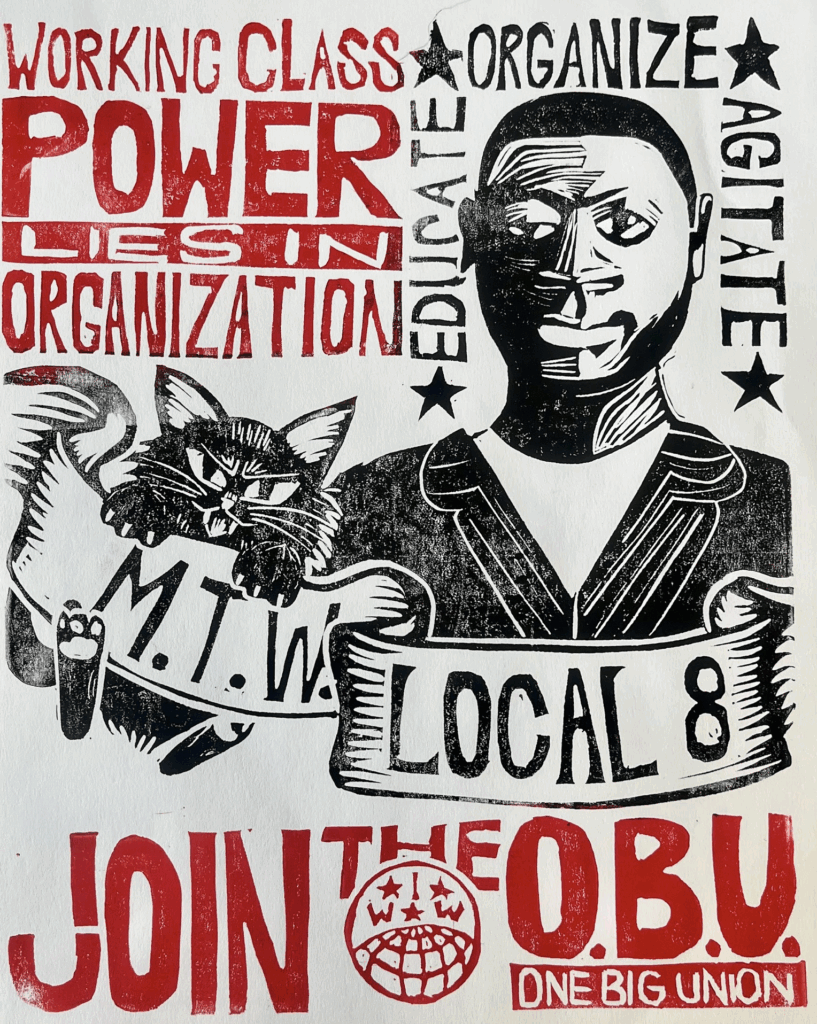
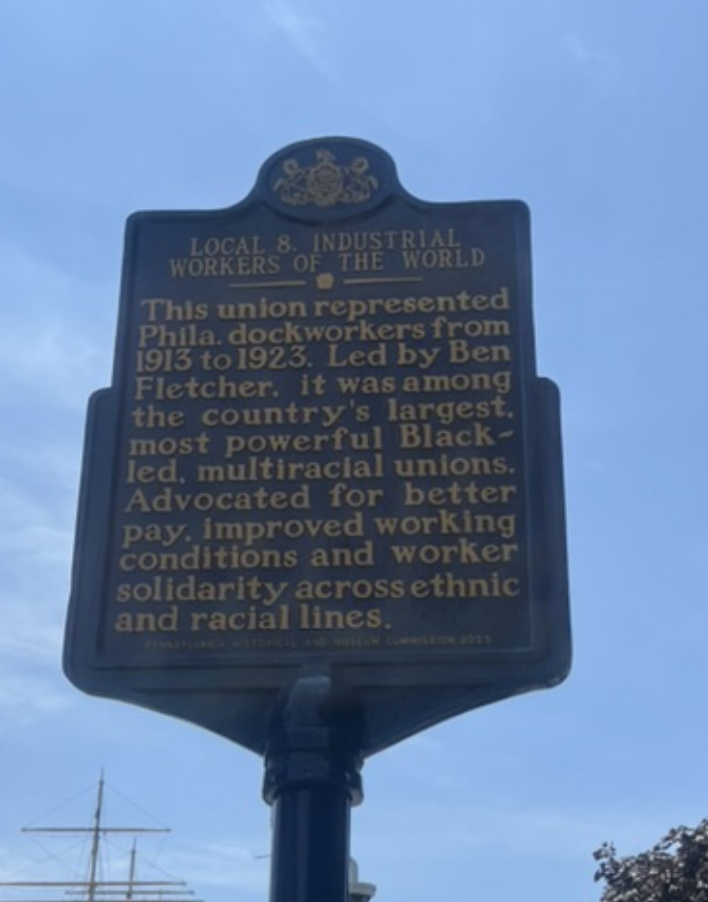
PHILADELPHIA, PA–On Saturday June 21, 2025 the Philadelphia Historical and Museum Commission unveiled its newest historical marker to honor the legacy of the Industrial Workers of the World (I.W.W.) Local 8 and labor organizer Ben Fletcher. A crowd of Wobblies and supporters gathered at Spruce Street Harbor Park on the Delaware River to celebrate their legacy of radical, militant labor organizing.
Statement from the Philadelphia I.W.W. General Membership Branch:
Ben Fletcher was a Black man in Philadelphia in the early 1900s who had less than a high school education. He could not join a mainstream business union and could not effectively vote, so it was very nearly illegal for him to do anything besides keep his head down and work. He knew he was not welcome in electoral politics so instead, he fought for a better world through organizing democracy on the shop floor.
He not only believed in a better future, but actively fought for it. He dreamed and fought for a Philadelphia where workers labor is recognized as the lifeblood of the city, a city free from the strangling grasp of the bosses and politicians. He achieved a glimpse of that with the Marine Transport Workers union, but was thrown in jail for showing the working class how close this dream was to reality.
Ben Fletcher knew what a lot of Philadelphians have forgotten today. He braved the lynching noose, the gun, the baton, and jail cell, to show us that when workers are united, we do not lose. He united workers across the race lines that the bosses use to divide us, and as a result, he built the most effective multi-racial and multi-ethnic, and most radical union in the US.
We must remember Ben Fletcher because he is a hero the Philadelphian working class created and his memory is still a threat to power, oppression, racism, and greed. As politicians and the owning class continue to ignore our needs and attack our right to organize, it’s important to understand the origins of racial segregation and systemic racism now as part of the system that is still with us and that we must actively combat.
As an international, multi-racial, and gender inclusive union that has been around for over a hundred years, our struggle continues today. We organize workplaces to improve our material conditions and help others trying to build democracy in their workplaces too.
Our struggle also extends beyond the workplace. We are united with the liberation of immigrants who are being targeted by ICE, we are united with abolitionists and the Stop Cop City movement. We are united with Palestinians fighting for their right for self determination. And we are united with the global struggles of all people seeking to free themselves from the clutches of imperialism.
Let this marker stand as a commemoration to Fellow Workers, both past and present, and a reaffirmation of our need to organize as a working class to abolish the wage system. We reject electoral politics and vote begging as a means of improving our material conditions and instead, we recognize that the solution to our suffering lies with each other. We welcome all who want to organize and strengthen the labor movement, so we can grip industries through militant working class solidarity and win demands.
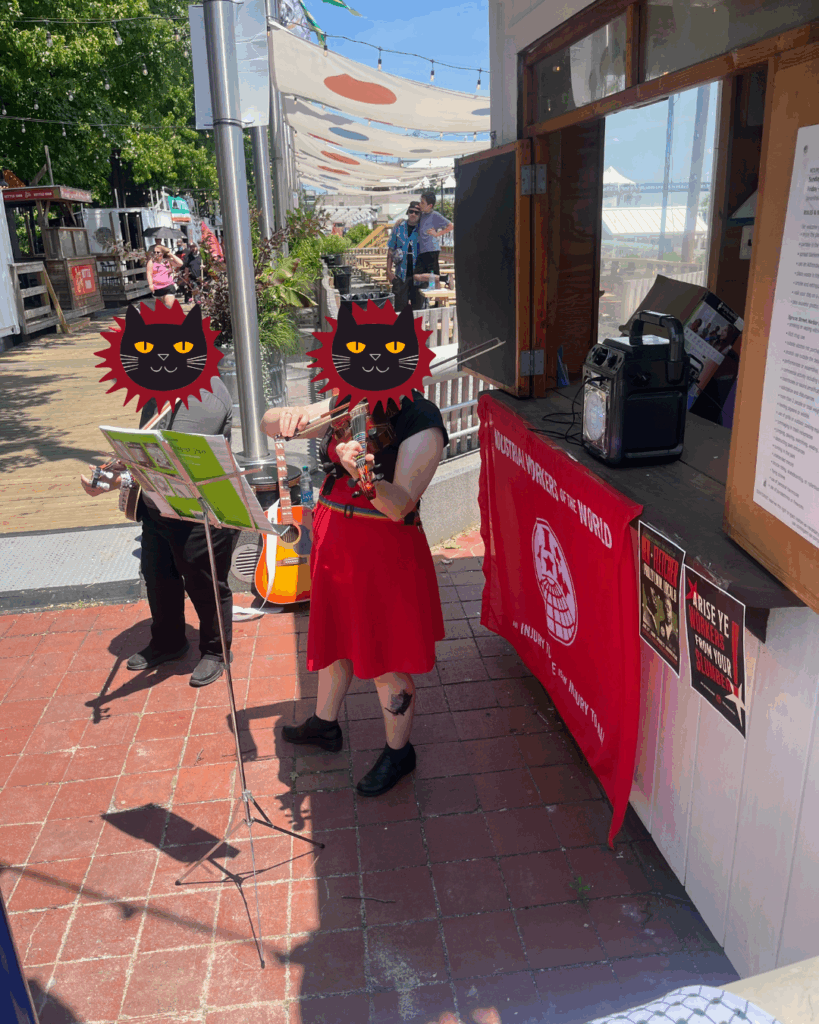
The event kicked off at noon with some good old union tunes with the attendees singing along in their little red songbooks. It was a sweltering afternoon, but the crowd was in high spirits. Passersby gave appreciative smiles to the performers as we passed out literature. Matt from DSA’s Racial Justice Committee spoke about the importance of preserving working class memory, and Fellow Workers from the Philly branch spoke on the marker’s significance to themselves, the chapter, Philadelphia, and the times in which we find ourselves today. Finally, we heard from Comrade Musa Bey – chair of the Philadelphia Alliance Against Racist and Political Repression. No politicians were invited to speak – the marker belongs to the working people of the city. We wanted to show the city what we can accomplish without the support of people in supposed positions of power. This marker is a reminder that these are our streets and we will not forget the legacy of working class power that Philadelphia created.
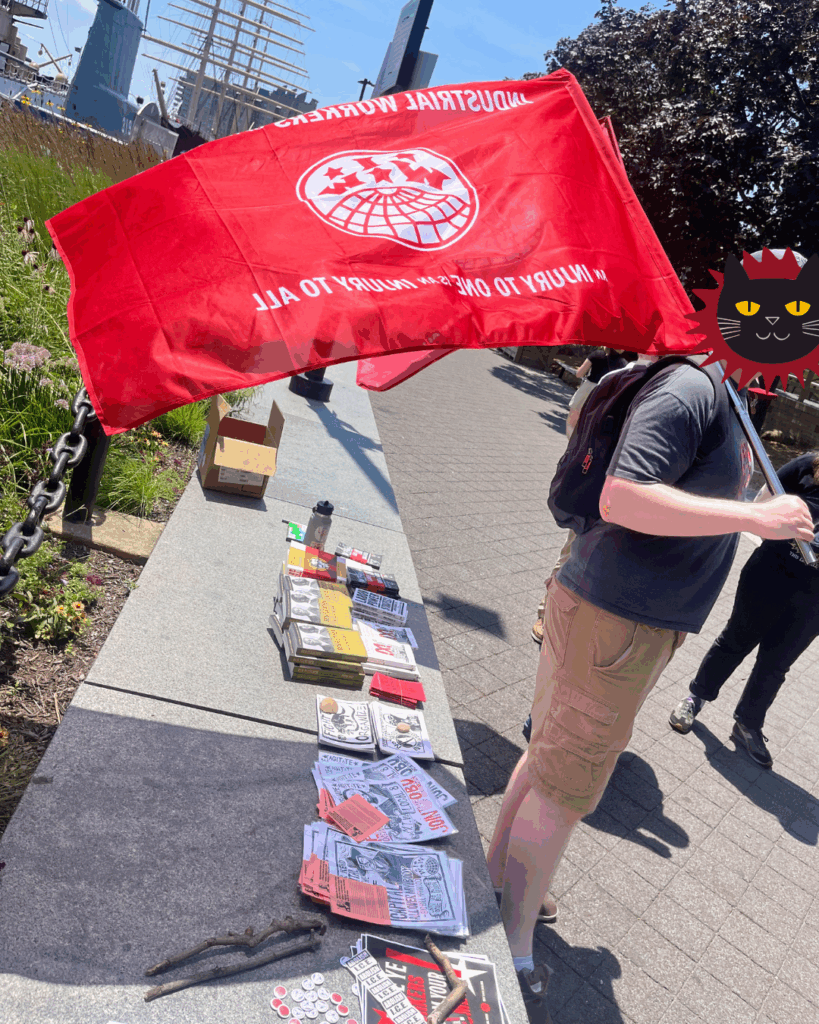
The Philadelphia I.W.W. Branch members spoke on how we actively engage in class struggle through organizing workplaces and shift the power dynamics in favor of everyday workers. FW Ben Fletcher and Local 8 showed us what is possible, and we must continue this struggle until we are organized as a class to take possession of the means of production, abolish the wage system, and live in harmony with the earth.
“It is the historic mission of the working class to do away with capitalism. By organizing industrially we are forming the structure of the new society within the shell of the old.”
FW Todd, our Branch Secretary, analogized our current moment to that of Local 8: “As I think about the days Ben Fletcher organized, they seem an awful lot like our own. In many ways, they were worse. Liberals will tell you what we’re going through now is unprecedented in U.S. history, but as I look back on U.S. history I don’t know what the hell they’re talking about! Oppression of black and brown people, using deportation as a fear tactic, and suppressing dissent are all as American as apple pie! So comrades and Fellow Workers, while liberals run around confused and scared, let’s take after FW Ben and diligently keep organizing. We’ve seen this movie before, and we’ll likely see it again, but if you’re truly committed to this cause, then you’ll keep fighting because you know that this cause is right. You’ll keep fighting because you know that when we fight, we win! So let’s rally around the red banner and stand together in solidarity!”
Comrade Musa Bey closed us out with a strong message to keep the Black Radical Tradition alive in labor organizing. “Ben Fletcher. A name they tried to erase — but one that still echoes through every labor struggle, every prison cell, and every Black radical’s heart.”
“As a young man, Fletcher worked on the docks — where the labor was brutal, the wages were low, and Black workers were treated as disposable. But unlike many, Fletcher didn’t just keep his head down. He started asking questions. Studying. Reading. Listening. And eventually, organizing. He joined the Industrial Workers of the World — the IWW — also known as the “Wobblies.” Now let’s be clear: this wasn’t just any union. This was a revolutionary, internationalist, anti-capitalist labor movement. The IWW didn’t just want better hours — they wanted to end wage slavery altogether. They believed, like we believe, that the working class has no borders, no color lines, and no obligation to obey their oppressors.
But Ben Fletcher did something even more radical. In 1913, he helped organize Local 8 of the IWW, right here on the Philadelphia waterfront. It was one of the first multiracial labor unions in U.S. history — Black, Irish, Caribbean, Eastern European workers all organizing together under Black leadership. Under his leadership. At a time when white unions excluded Black workers, Fletcher united them. When the bosses tried to divide by race, he united by class. Local 8 didn’t just hold meetings — they shut the port down. They didn’t just make demands — they enforced them. They won control of hiring halls, created democratic workplaces, and refused to allow scabs to break their strikes.
That was Black power. That was revolutionary unionism. That was Ben Fletcher.
Ben Fletcher is the Black Radical Tradition. He belongs to that long line — from David Walker to Ida B. Wells, from the Garveyites to the Panthers, from MOVE to the youth organizing today. He knew what we know: that racism and capitalism are not separate systems — they’re married. That labor rights without Black liberation is just white supremacy in overalls. That freedom can’t be negotiated — it must be taken.
And just like in Fletcher’s time, the system still represses those who dare to fight back. We are still losing lives to police terror — Robert Jones, Aaron Rainey, Walter Wallace, Eddie Irizarry — say their names.
We are still watching political prisoners like Mumia Abu-Jamal rot behind bars while killers walk free. We are still being told to be patient while they bomb Black and Brown nations — from West Philly to Rafah.
But Fletcher teaches us that solidarity is our weapon, and courage is our tradition. He reminds us that the people have the power to shut the system down. That multiracial, working-class unity isn’t a dream — it’s a strategy. That you don’t need a PhD to lead a movement — you need discipline, principle, and love for your people.
So what do we do with Ben Fletcher’s legacy?
We don’t just honor it — we use it.
We organize our workplaces.
We study our history.
We fight political repression — at home and abroad.
We build organizations rooted in radical love and revolutionary discipline.
We refuse to separate the labor struggle from the Black struggle, from the anti-police struggle, from the anti-colonial struggle.
And we remember:
Black life is resistance.
To be Black, alive, and fighting — that alone is an act of defiance.
So say it with me:
Ben Fletcher lives.
In our strikes. In our protests. In our campaigns.
In every time we say NO to repression and YES to liberation”
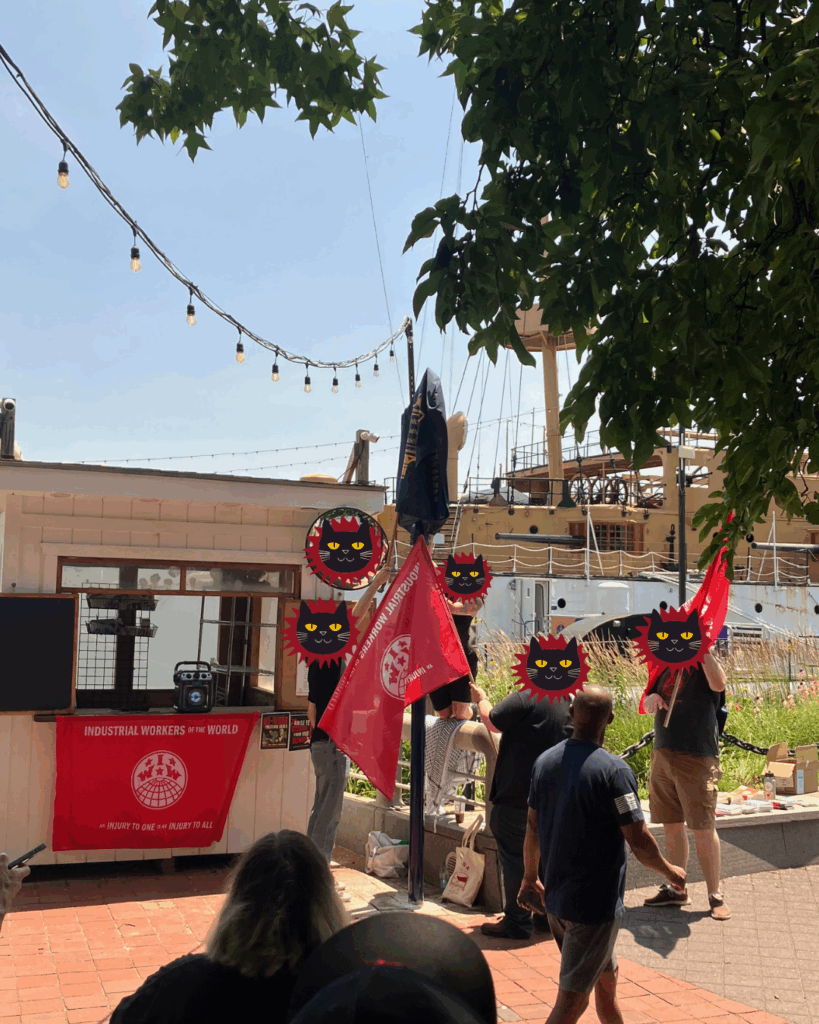
Not only was the city overdue to honor this labor hero and movement, but the ceremony itself was the culmination of years of effort. Our branch has been working with the local DSA chapter on this project for years. We unveiled a mural of Fletcher and Local 8 last May just down the boardwalk from where the historical marker now stands. Read more here.