Over the last 15 years labour activism has gone from being a marginal force on the left to one of the primary areas of focus for activists looking to change the world. Some of this is due to the worsening economic situation of almost everyone, especially formerly middle-class professions.
Some of it is also because a union staff job is one of the few stable, decent paying jobs left for progressive intellectuals remaining (in some ways it actually has replaced the role academia has played on the left prior to now). What is most interesting though is that while radical critiques of labour abound, the actual practice of labour activism is extremely narrow.
The ironic result of this is a deep and abiding belief that anything that does not look like the existing unions is a failure. Instead the conventional wisdom is that the current impasse in the labour movement is the result of betrayals by incompetent or unprincipled leaders. Everyone believes there is no alternative, and everyone else is doing it wrong.
Unions Are Political
The surest sign of bureaucratic capture in a movement is that every conversation about politics is just about technicalities. If you can’t tell in the first ten seconds if someone is talking about a hockey game or a campaign by some workers to achieve a goal you may be in the inner circles of the labour movement right now.
Something being a bad look, the conventional wisdom declares, is worse than being a bad idea. The goal is furthering the popularity of the spokespeople of an idea and not the power of organizations themselves.
A perfect example is the clumsy attempts at adopting the Green New Deal by many supposed radicals and the debates around this policy discussion. On one hand many “radicals” want to revive massive state intervention in the economy to steer development away from destroying human civilization. On the other hand they completely fail to take account of the fact that we are living with the consequences of the problems the original New Deal failed to take on–including the pressing need for workers (the vast majority of society) to control the economy in a meaningful way to prevent ecological disaster.
The New Deal wasn’t a gain marked by militant labour; the entire welfare state project was a move to take workers out at the knees. It was a response to a global wave of revolutionary activity by workers. The response was not to give workers more power; it was to grant them concessions such as more pay and, in many cases, less control over the job.
Workers were fighting for more control over the economy through organizations they built themselves (Industrial Unions)–instead, they were given comprehensive collective agreements that tied them even more tightly to the employer.
No-strike clauses were traded for increases in pay and predictable bargaining. Social programs distributed wealth downwards but removed popular control of institutions like unions and working class community organizations. Instead of workers driving their organizations through their own activity they were invited to elect people from elite universities to administer the programs for them. The old socialist movement did not see victory strictly in terms of the amount of the economy captured by the public sector. They measured it in terms of the amount of control ordinary working people had over their lives. Nationalization was one of many tools to further working class control of the economy. Keynes and the New Deal policies represented a retreat from overt class struggle.
Another tool was revolutionary industrial unions. These mass organizations were a type of union that included the IWW as well as the left-led CIO unions. These organizations were agnostic on nationalizing their industries. Their primary goal was to wrestle concessions from the employer on the job and use those to build power outwards from the shop floor. The early United Electrical Workers at their height had 600,000 members and half of them were not under any formal collective agreement with the employer. The Canadian Merchant Seaman’s Union had a profound effect on maritime communities and influenced national policy in Canada through their power on the job.
The Western Federation of Miners built a system of hospitals through their own resources and pressured employers in a way that drew a direct line to the implementation of public healthcare in the Province of Saskatchewan and then the rest of Canada.
The IWW was unique and essential in that it represented an attempt by unions of this type to build a comprehensive system that could sweep aside political parties and the business class politics of Parliament or the House of Representatives.
There is a myth that competent professional actors built the post war compromise, this being government services and union rights that followed the pitched battles of the 30s and 40s. That is simply ahistorical nonsense. Working-class organizations took seriously their task of replacing the politics of the era in which they operated, and the welfare state was a concession in the face of a rising tide of militancy.
Those that do criticize this approach are not met with political arguments. They are met with the assertion that they are incompetent. This is an important move because to acknowledge there is a debate at all on the fundamentals of the Labour Movement is to acknowledge there can be alternatives.
Where Are These Unions Now?
Let’s start with the hardest truths first: the labour movement is not actually growing. Hype about the labour movement is growing. Union communications are a booming industry and there are some exciting new and interesting ideas out there. There’s also a lot of bullshit. Most of this bullshit exists to funnel people towards dead-end reformism during election years.
There are some historically radical unions that are still standing on their own two feet: The ILWU, the United Electrical Workers, and the Canadian Union of Postal Workers are all unions where it is worth reading the Preambles of their respective constitutions. They also have largely thrown in the towel on the question of workers’ control on the job because they see this project as exclusively a matter of formal collective bargaining.
On the whole, radical unions were almost entirely wiped out by the late 20th century and until we overcome the roadblocks represented by the current system of contract administration and labour peace we aren’t likely to see meaningful growth.
The fact that the UAW, the Teamsters, and SEIU are seen as the main battlegrounds for groups like Labor Notes shows you just how far back the horizon of possibility has receded. The “radical” alternatives outside the IWW are of two types:
- Caucuses that periodically take over these unions and then splinter and collapse into finger pointing and recriminations.
- Progressive unions like the Chicago Teachers Union or CUPE in Canada that manage to be politically stable but largely by outsourcing the main conflict onto political terrain outside the workplace and thus can safely not worry about their rhetoric running up against their practice. They do this by putting hard questions onto the political game and look for legislative changes from well-meaning politicians instead of dealing directly with the limits of their own power and discussing how to expand it through organizing.
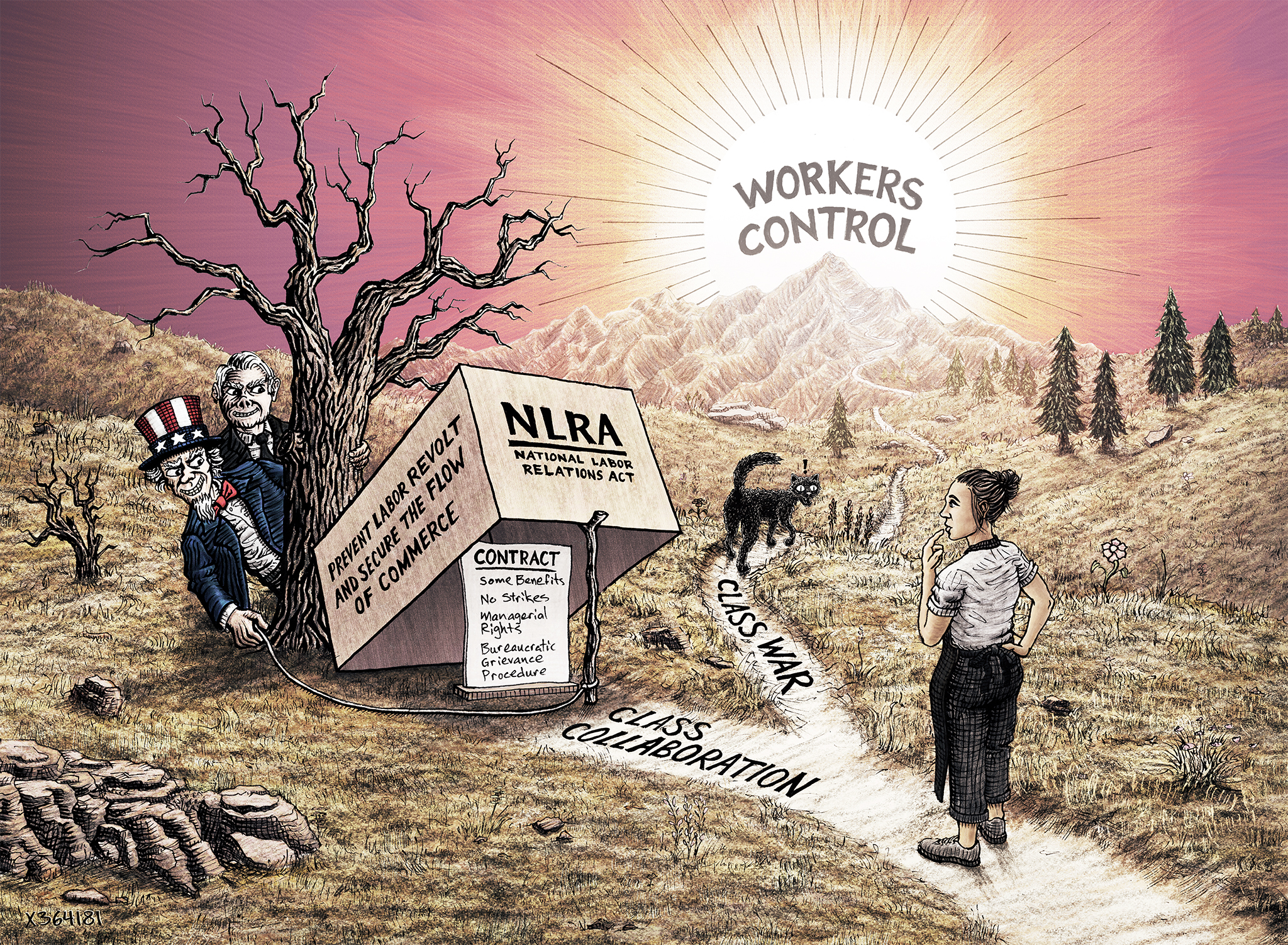
The truth is the “conservative” unions are in their basic components the same as the progressive ones. They negotiate a contract, and service these contracts through a grievance procedure. The degree to which a union is successful is the degree to which they can expand the number of workers paying dues to administer this machine. How “radical” they are is determined by the brand of politicians they support.
However, class struggle on the job is as lively as ever, sometimes within (reluctant) unions, sometimes outside of them. At times it is scattered or appears spontaneous and other times it is methodical and smart.
What is a Win?
Labour Relations realism can be clearly seen in the intersection between labour history and union strategy. Unions will talk about union density as if it contributes to their power but are only measuring membership by who is covered by a collective agreement. Those statistics can be impressive. Union membership can cover tens of thousands of workers. But they don’t measure their activity, if you look at the number of shop stewards and the number of grievances filed, the turnout at meetings or any other standard marker of engagement the unions are empty.
Policy changes—like sectoral bargaining, where unions are granted bargaining rights for entire industries through legislation and policy changes, double down on this problem, increasing the legal representation without building anything deeper on the job. Union statistics are marshaled selectively and while some critics are pointing out that union membership is lower than it has been since the Wagner Act system was put in place, they neglect to mention that prior to that, most unions did not have much by means of compelling membership. The situation is far more dire than the numbers show. Union participation is likely lower than it has been since unions were able to keep records of their membership at all.
When a worker signs a union card in an IWW campaign it means they are involved in something and joined willingly. When a worker receives a union card in the mail from an AFL/CIO/CLC union it means they were signed up by someone else for something they did not ask for.
Participation can follow being in a standard bargaining unit, and a worker may sign up in the IWW and not be involved at all but the actual act of signing up does matter. The content and the politics are fundamentally different. You can get data from both of these things but they say very different things if you take those numbers seriously. The collapse of the NLRB in the USA is not due to politicians failing to uphold a vital institution. It is due to the fact that there is very little left to mediate with regards to class struggle.
While conflict on the job remains, strikes are less frequent and happen in a more legally determined pattern than anyone has seen in human history. This has reached the point where unions are on life support and that life support system is the labour laws of the country. It used to be that unions could take action to force changes in laws. Now they believe they need changes in laws to take action.
If unions need the NLRB to exist, their politics are always going to be the range of politics possible under the NLRB. For unions to lead working class politics they need to be founded on something other than labour law. This again is evidence of bureaucratic capture. The idea that there is no alternative to official channels of power, that all power is in the final analysis a matter of policy, is an important imperative for the entire labour movement as it exists now. Again, speaking in terms of winning a raise, or getting rid of dangerously defective equipment is seen as evidence of being short-sighted at unionism—not merely politically wrong. “Competent unionism” is to have these things addressed (or just as often not addressed at all) through contract language. Sure the workers may be happy with the results of their job action, but what about the relationship with the employer? What does the collective agreement say?
…How the Light Gets In
There is an important reason why no one will criticize Solidarity Unionism on political terms—they all believe they are doing the same thing, only better. They are just more practical. All organizing involves a huge amount of compromise; you should be pragmatic when taking on an organizing project. But when you certify a unit, then sign a collective agreement that hamstrings your ability to strike, or hand your finances or political power to a politician it’s a “bad look” to say you know what you’re doing. So instead you say the ones who are not making the same compromises are inept or too rigid if you see them as competition in any way.
So are alternatives impossible? Is it a completely closed system without an alternative within it? Yes and no.
There are unions without recognition (and collective agreements), for example public sector unions in the US south, the IWW’s Solidarity Unionist projects also show these organizations are able to exist, from the IWW Starbucks campaign, to CapTel, to Stardust. The question is whether the resources or energy are put into them and whether we will keep making excuses for not doing what we know works.
Other unions also have Direct Action projects that end-run the grievance procedure. These go beyond structure tests and involve pushing demands to management outside of bargaining. As collective bargaining and the legal scaffolding that props bargaining up continues to be undermined these campaigns are going to be seen as increasingly practical.
The pieces of the labour movement we need are not hypothetical. It’s not some experiment that needs to be proven. It’s all in existence already. There are long term stable projects without recognition, unions that are politically independent, and large scale direct action programs. It’s the IWW’s job to take these pieces and put them together.
The IWW’s role is more important than ever. The IWW is not important as a union with historically very progressive politics (this is something important but the IWW is actually not very unique on that point); not as a union that organizes everyone on the job (most unions outside the building trades have been doing this for almost a century); but as a union that can push past the actual labour movement and open up directly democratic ways of operating. This can look like job branches instead of shop stewards, marking wins through employer concessions instead of contract language, and taking action over real demands instead of symbolic protests. What the IWW is doing only looks impossible because no other union will dare to try and the IWW’s willingness to do this alone is a tremendously powerful thing.
Disclaimer: The opinions expressed in this article are those of the author. They do not purport to represent that of the IWW or Industrial Worker as a whole.