
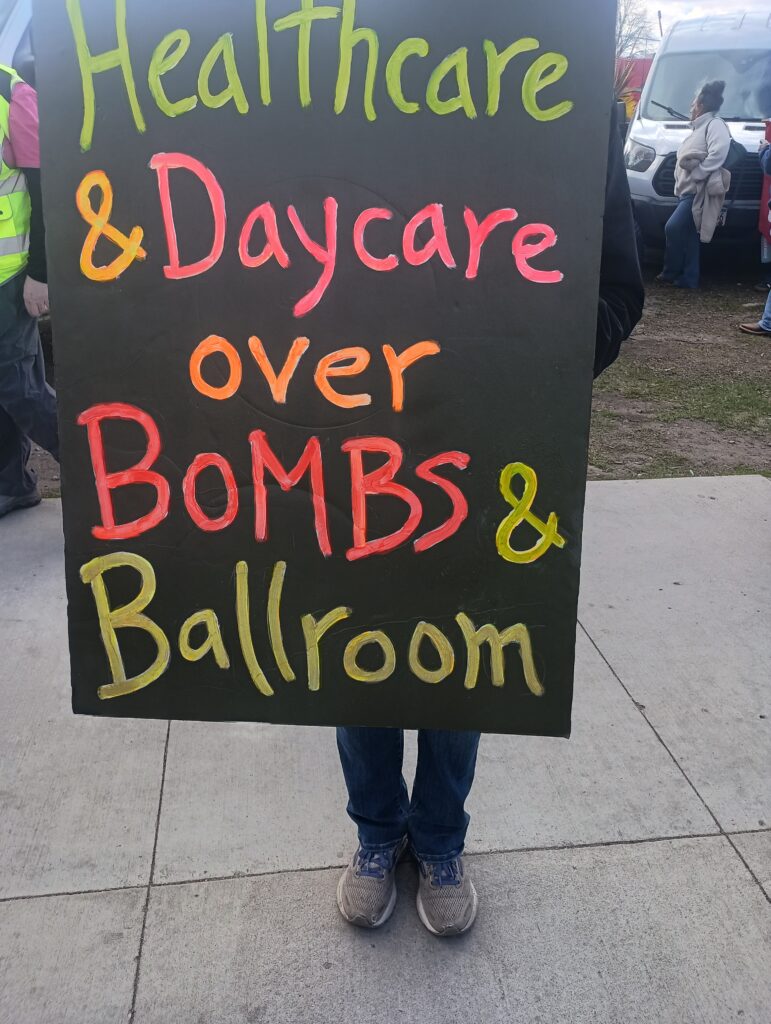
The first International Workers Day hinged on the May Day festival and the strike for the eight hour work week, according to activist Lucy Parsons, who was involved in planning the first May Day strike in 1866. But it would only evolve into the holiday it is today after someone threw a bomb at the rally in Chicago. In response, the government would round up and hang prominent organizers of the time, including Louis Lingg, who was not even present at the rally. These men would become known as the Haymarket Martyrs and their deaths would be the groundfire underpinning May Day celebrations around the world in the years to come.
Minneapolis knows something about martyrs and they know something about strikes. The January 23rd strike brought more than 70,000 to the streets of Minneapolis as people marched against ICE in -47 degree Fahrenheit weather, demanding justice for Renee Good, the young mother shot three times by an ICE enforcement agent, and justice for their neighbors kidnapped off the street. The mood that day was less defiant than euphoric as people spilled out of apartment complexes in Minneapolis and St. Paul, or drove into the city from Red Wing or Duluth in hurt and anger, only to find themselves flanked by others. And across Minnesota, one in four people participated in the strike.
The next day Alex Pretti was shot in the street in front of a donut shop after helping a woman ICE had been attacking.
Yet Alex Pretti’s murder, like the murder of Renee Good, appeared to only stiffen the resolve of the strikers. Mothers continue to tend to children whose own mothers have been taken by ICE, neighborhoods came together to keep one another housed and organizers organized as the success of the No Kings rally in March demonstrates.
In the weeks that followed Pretti’s murder, organizations bled together as people who knew Alex and Renee met with politicians and union organizers. People from across the Twin Cities came together to unravel this new tragedy. In those crammed rooms, it seemed like all the different microcosms of the city were represented. It was the very same solidarity that brought about May Day.
The IWW and Interlocking Unions
In many ways, this crosshatching of communities in Minneapolis is what underpinned the original idea of the IWW. This union, after all, was intended to represent all industrial workers of the world with the idea that if one union went on strike, that that union would be supported by all the unions.
Minneapolis took this idea and applied it to neighborhoods. The understanding of a neighborhood grew until it encompassed the whole city, and then the whole state, in the aftermath of Operation Metro surge. After all, what is a state or a nation but a collection of neighborhoods? What is a union but the same?
Union 17’s May Day strike highlights not only the power of interlocked unions but also how strikes can be seen as a subtle reordering between neighbors. Union 17’s 10 a.m. walk-out at the Hotel Ivy and the Normandy hotel on May Day was not only their first strike. It also kicked off a day of union organizing, beginning with the hospitality workers, followed by the folks at Hennepin County Medical Center who are fighting for the very survival of one of the city’s main trauma hospitals, the negotiations of the Target Field workers, and ending with the long May Day March led by Mirac.
The strikers were not alone in any of these actions. All striking workers were joined by representatives of other unions and members of the community. Union 17 was joined by members of the Inter Faculty Organization (IFO) and the graduate student union at the University of Minnesota among others. As Jennifer Chernega from the IFO told the Industrial Worker, “It’s really important for all workers to come together, even if they do very different kinds of jobs, because we have more in common with each other than the bosses.”
But it was a worker from Union 17 who pointed out the sense of betrayal that finally pushed the workers to walk out that May Day. She had worked at the Normandy for over 20 years and was still paid less than hospitality workers in other parts of the city. All she and other workers wanted was to be paid the same as other workers, receive steady hours and ensure that the guests’ rooms were cleaned daily. If all three needs were met it would allow her and her coworkers to receive a steady income that would allow them to survive in an economy buffeted by ICE, inflation and a new war with Iran. Instead, workers had received silence, at least, until they walked out.
Within an hour of the walk-out, a union representative for Union 17 reported that management had called to enter into negotiations.
Hours later, members of the striking unions joined together for the May Day march. They celebrated their wins, rued their ongoing battles, and ultimately they celebrated each other. As they flowed out from the intersection of Lake and Chicago, they chanted, “ICE OUT NOW!”
Proving that while the weather may be warmer, the January 23rd strike is still under way. An injury to one is an injury to all.
This article appeared in the 2026 May Day edition of Industrial Worker.
Haz clic aquí para leer en español.