
Members who attend educational and organizing events share what they learned with the members whose dues funded their attendance. This model seeks to recognize and follow the “each one teach one” philosophical tradition rooted in the cooperative and agricultural work of George Washington Carver, who believed that practical knowledge shared freely was the foundation of community survival. With that in mind, here is what I brought home from the 2026 Pennsylvania Association for Sustainable Agriculture, or PASA.
PASA “supports sustainable farms and equitable food systems through farmer-driven education, research, and community.” I particularly admire their focus on online and in-person workshops and events grounded in research on sustainable environmental practices. I’ve attended classes and field days they’ve hosted, such as tractor safety and small engine repair, or walking through the basics of chicken tractors, rotational grazing, and other practices that benefit both soil health and the broader environment.
One of the best parts of PASA is their yearly gathering in Lancaster, PA, where people from throughout the food system come together to compare notes on what they saw and learned over the past year, sharing what’s working in sustainable agriculture and what’s helping build more equitable food systems in their communities. February, though, is mostly a time for planning and getting ready for the next season; things are at least a little slower, and that gathering becomes a rare chance to socialize with other workers you otherwise wouldn’t meet or barely get to see.
One of the reasons we’ve started our organizing in sustainable agriculture, cooperative, and food sovereignty spaces is not only because we care about non-extractive, even regenerative, practices for the environments in which we live, work, and grow, but also how that relates to non-extractive, even regenerative, practices in workplaces and communities. It’s not hard, in conversation with others in these spaces, to draw the same parallels of environmental sustainability toward labor sustainability: that the same principles calling us toward sustainable, non-extractive, even regenerative relationships with the land also apply to how we structure work and treat the people doing it.
A smaller conference, a harder year
I have attended PASA each year since 2021. This was the smallest I have seen. It is my understanding that in 2025, the conference broke attendance records, with over 3,000 people, a large and active trade show, and some of the strongest worker-focused programming in recent memory, including multiple sessions from the organization Not Our Farm. This year, their absence was felt. Booths that had been there for years were gone. The trade show looked thin.
The reasons were not hard to identify. DOGE cuts to USDA programs, including but not limited to climate-smart agriculture funding and grants specifically targeted at historically disenfranchised farming communities, have hit this sector severely. Programs that existed to begin repairing trust between the federal government and farmers from historically marginalized groups, whose trust was broken over generations of discriminatory policy, were among the first to be eliminated. For a while, there were questions about if the gathering would happen at all this year. Scholarship funds that covered housing, food, and travel in previous years weren’t initially available. All of that uncertainty, plus the threat and fear of ICE make the decision to travel not worth it for many.
PASA President Hannah Kinney Smith opened by acknowledging it directly: “This community has been spread thin. Funding has disappeared. And yet the relationships sustain, a movement built on genuine human connection, on trust built over years of showing up together, is more durable than any grant.” She also reflected on the importance of leaning into our differences rather than papering over them, because “differences strengthen a movement when they’re held with honesty.” We must stay in relation with each other, she said, long enough to learn from each other and move through our struggles together.
I will focus on two workshops I found particularly insightful.
The means of production and cooperative exploration
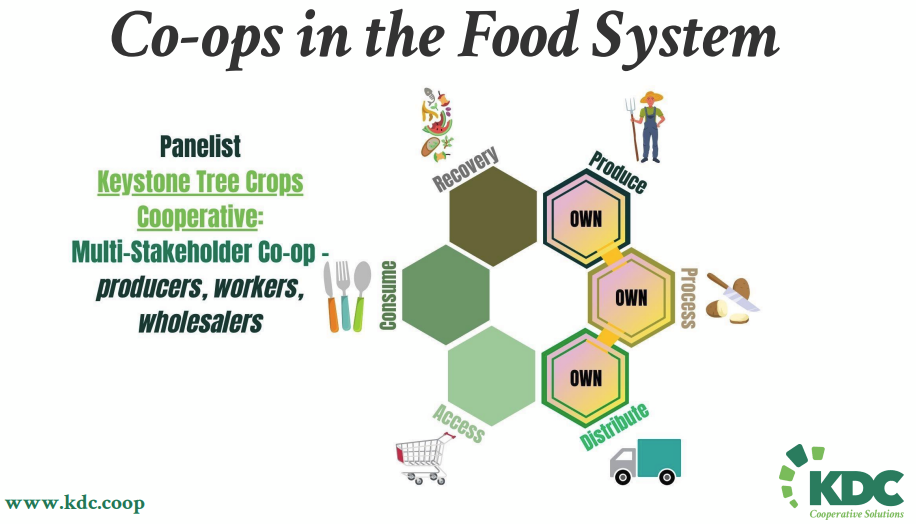
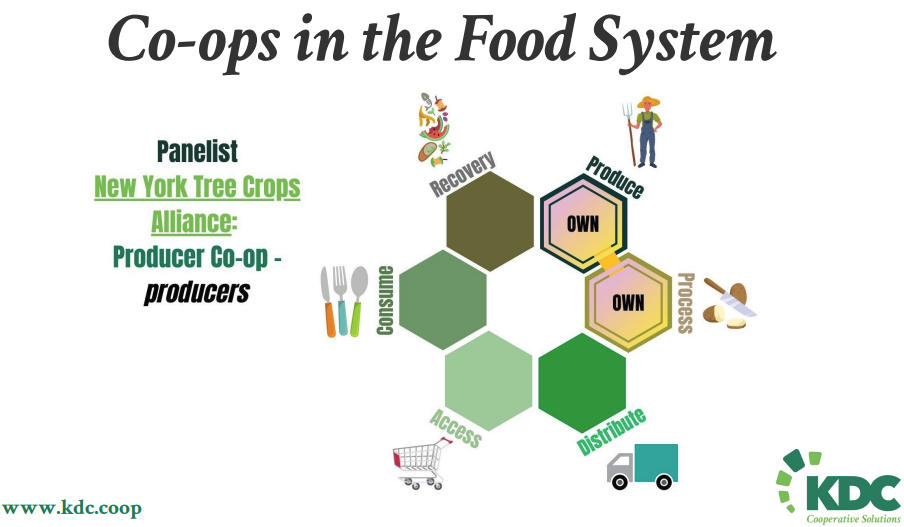
The agroforestry cooperative panel about building markets in this budding industry, featuring representatives from Keystone Tree Crops Cooperative (KTCC), Avellana Agroforestry Cooperative (AAC), and the New York Tree Crops Alliance, was facilitated by Fellow Worker Mat Forth from Keystone Development Center (KDC). FW Mat has worked closely with KTCC and AAC through his work as a Cooperative Developer at KDC, providing technical assistance with organizational development, business planning, and governance design.
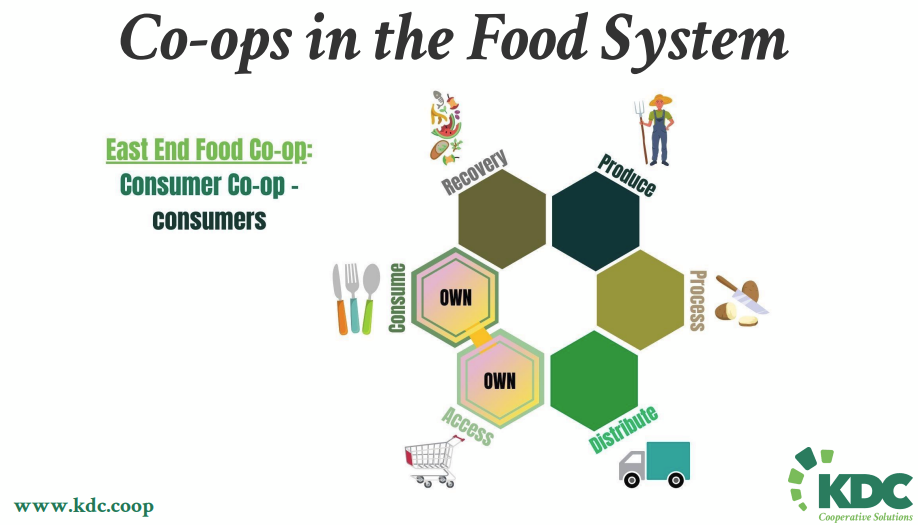
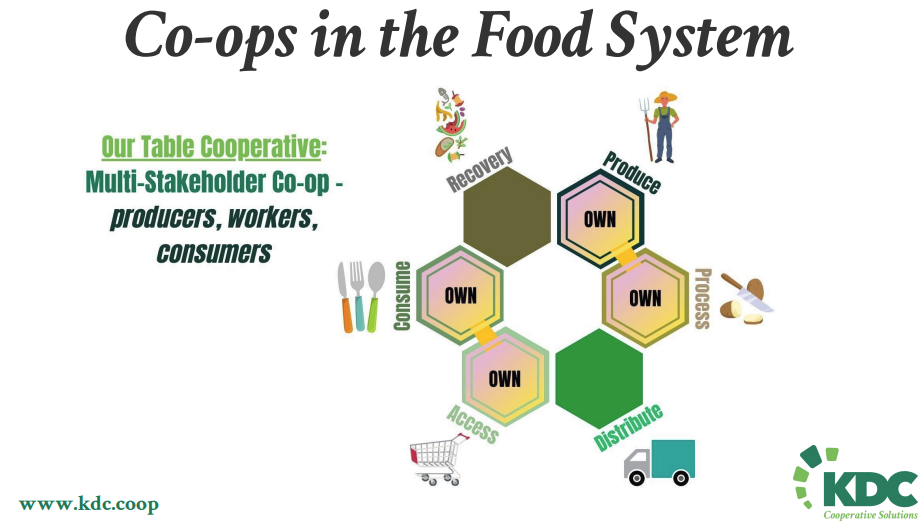
The session offered helpful tools for understanding how cooperative control can be built across a food system, not just at the point of production, but through processing, distribution, and sales, providing ownership to different stakeholders across the supply chain. The food system map they presented showed each of these nodes clearly, and the examples they gave illustrated how different cooperatives are organized to address different points in that chain, such as Avellana Agroforestry Cooperative, whose grower members benefit from the shared ownership of the means of production and processing.
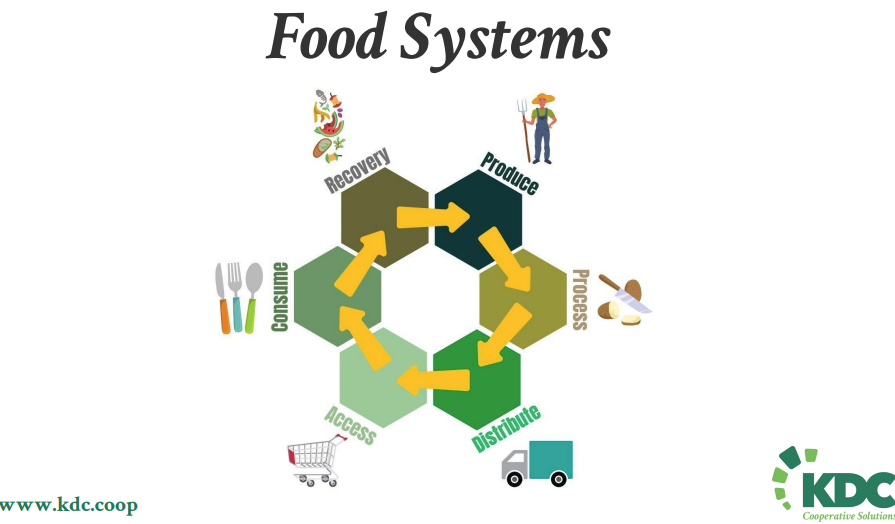
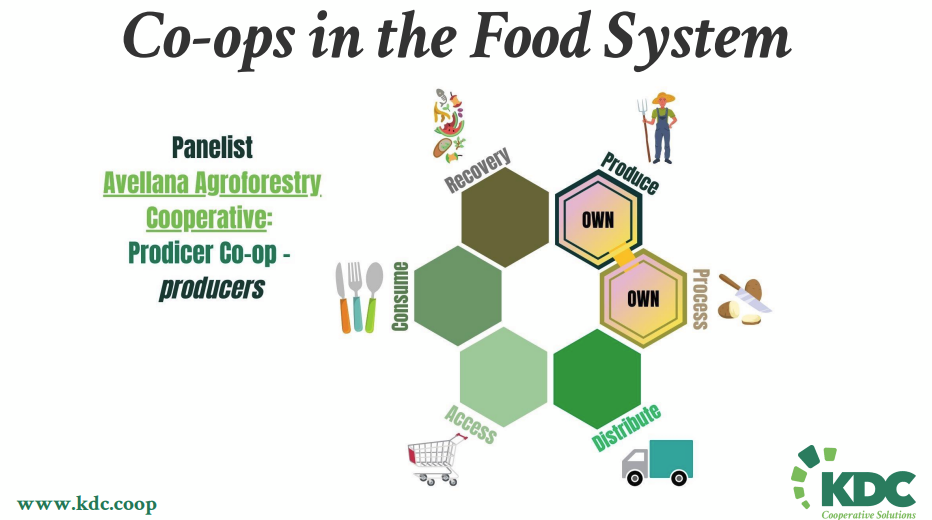
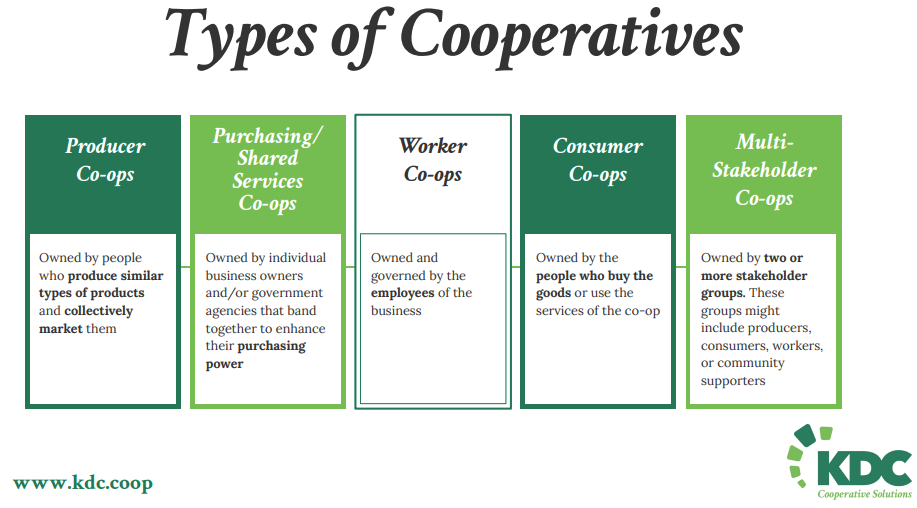
When thinking of cooperatives, many people think of consumer co-ops and the grocery store model that had a resurgence in the 1960s and 70s. The cooperative movement, however, has a longer, richer, and more diverse history than most U.S. schools ever teach. We, of course, need to also pay homage to all oppressed groups of people who have used cooperation as a means of liberation since the dawn of time. Worker cooperatives, multi-stakeholder cooperatives, and producer cooperatives each distribute ownership and governance differently, and each positions workers differently in relation to the decisions that shape their labor.
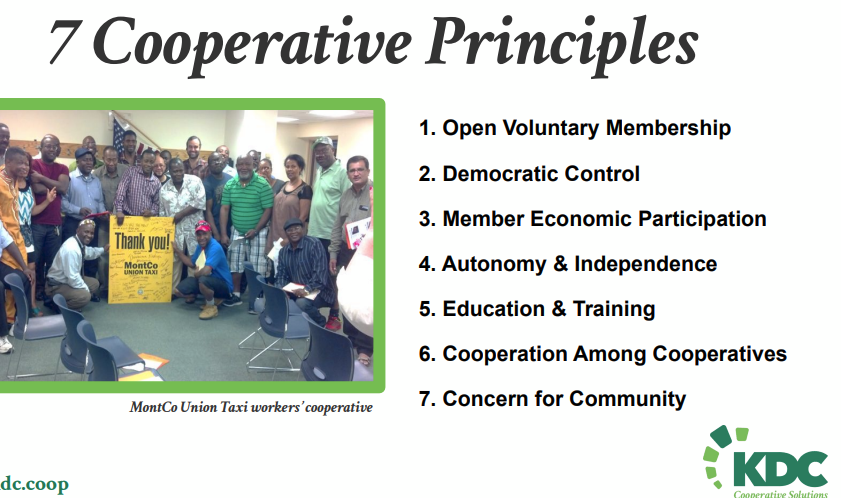
The 7 cooperative principles, the framework of which was first formalized by the Rochdale Pioneers and adopted across the cooperative movement internationally, have significant overlap with IWW values: democratic member control, member economic participation, autonomy and independence, education and training, cooperation among cooperatives, and concern for community. We have come to learn how many of these values overlap with our union values, partly because a lot of the history of cooperative struggle is also the history of labor struggle. For more on that history, we encourage fellow workers to start with Collective Courage: A History of African American Cooperative Economic Thought and Practice by Jessica Gordon Nembhard, who beautifully speaks to how cooperatives provided a means for self-determination.
In a multi-stakeholder cooperative, different actors in the production system, growers, workers, buyers, and community members, all have the potential to have formal seats at the table. This may look like a Board of Directors made up of each representative member class. Rather than any one group extracting value from the others, the cooperative structure creates accountability across the whole chain as each membership class incentivizes each other to collectively bring benefits to one another through a transparent business model that values and rewards what they each can bring to the table. It doesn’t resolve all tensions, but it builds in mechanisms for those tensions to be named and worked through collectively.
Communities of practice and the structure of trust
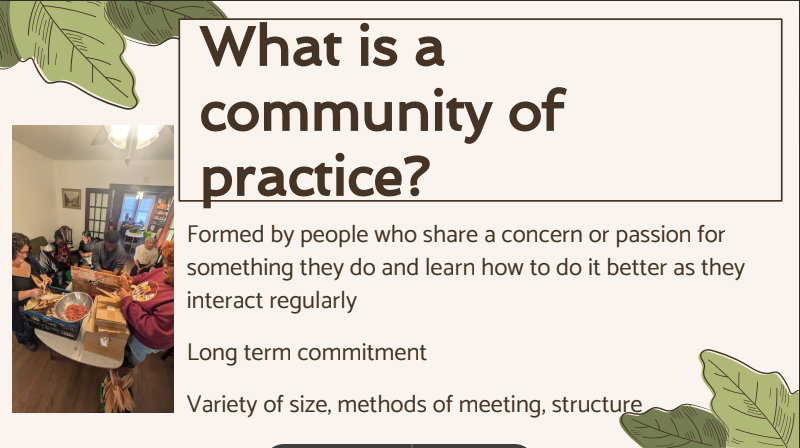
The Communities of Practice project and presentation, developed by Ebony Lunsford Evans of Farmer Girl, Eb Madison Mclean of Library Seed Farm, Bernard Sekey, and Dr. Laura Livingston from the School of Sustainability at Chatham University, reported back on their Communities of Practice (CoP) research project, which brought together seedkeepers and produce aggregators in peer learning groups several times a year, remotely and in person when possible. A community of practice is “formed by people who share a concern or passion for something they do and learn how to do it better as they interact regularly.” This reminds me of what we try to do through our union efforts and gatherings.
The model brings together people doing similar work, creating a consistent space for peer learning and honest exchange, and ground the whole thing in shared values worked out collectively from the beginning. One of the first things each group did was talk through their values together. That groundwork, the presenters found, was critical to everything that followed.
The values the groups developed: collective responsibility, valuing practical knowledge, praxis, community building, reflection, and continuous social learning, showed up in concrete practice. People shared what was working in their operations, identified gaps in their collective knowledge, coordinated access to resources, and documented what they were learning together.
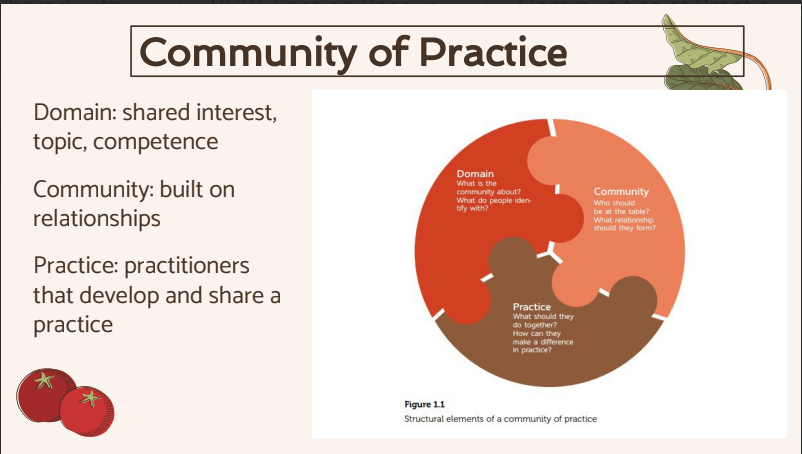
This made me think of the ways the IWW can function as a community of practice. We share a concern and passion for worker empowerment and emancipation of the working class, the planet, and its resources from authoritarian and capitalist control. Our union is a vehicle through which we learn, connect, share notes, and learn how we can organize better over time. Members are interacting regularly in their workplaces, localities, and at union events like OTs, regional gatherings, organizing summits, convention or other organizing events the union helps facilitate.
What the groups heard consistently across both communities of practice is worth sharing, because I think in many ways it maps onto what effective union organizing requires:
Consistency builds trust. Predictable systems for communication, logistics, and decision-making mattered more than flexibility. Dedicated facilitation and clear roles reduce burnout. Newer and smaller participants need intentional entry points, mentorship, and shared resources. Access to the group cannot be assumed; it has to be designed and intentional. The tyranny of structurelessness that can occur without accessibility intentionally integrated into design is real.
The project also paid agricultural workers for their knowledge and time in the room. That decision was named explicitly as part of trust-building. It recognized that knowledge, time, and energy has value and that asking people to contribute it for free reproduces labor extraction models we seek to move away from.
You cannot rely on goodwill and enthusiasm alone to sustain collective work over time. Mission-driven workers don’t always prioritize profit, but we live in a society that forces us to trade hours of our lives for money in order to survive. If we can reduce that burden for our members, we should strongly consider it, or we will only attract the most privileged who are better able to afford to make that choice. We can’t afford to ignore these questions; we must seek to understand our different ideas, values, and capacities, and stay in community long enough to sort through them together while understanding there will be some variation based on local and regional conditions and industry.
What we built and what we’re building toward
Even though overall conference attendance decreased, our IWW presence at this conference more than doubled compared to last year. That is the result of building relationships in community with fellow workers in food systems, insisting that if we are going to talk about ecological sustainability, being regenerative as opposed to extractive, then we need to think seriously about labor sustainability and how this form of labor needs to move away from being so extractive, in large part because of this industry’s deep historical and modern day ties to slavery and human trafficking. We checked in with our members to see what funding in travel, housing, registration, and food each fellow worker needed to attend to make connecting to each other and others in the industry as accessible as possible.
We need to talk about labor and make sure workers aren’t left out of the discussion, showing up consistently, being the people in the room, making sure to ask about labor practices, and making it safe for others to ask those questions too.
Despite the right-wing attacks on the BIPOC, queer, women, and other historically marginalized groups, food system workers from these groups are continuing to build their networks within a sector that has historically been hostile to them. The conference holds space for this, and that is one of the reasons we keep coming back and bringing more people. These communities of resilience are not separate from the organizing work; they are part of its foundation.
Nearly 40 percent of all U.S. farmers are 65 or older. As that generation retires, millions of acres of farmland and hundreds of thousands of farm operations will change hands. The question of who they pass to private buyers, corporate consolidators, or worker-owned cooperatives is one of the most consequential organizing questions facing American agriculture. There are already models being built for how to support farm succession into worker cooperative structures. The IWW should be part of that work by investing in member education and organizing around worker and community ownership of labor and land. It is still early. It is the part of the process that is like a seedling still coming together, still growing stronger every day. We are working on our community’s “soil health” so we can grow strong roots.
FWs can get involved with either the NARA-wide IWW cooperative council or the agriculture and food system organizing efforts, Agriculture Workers Organizing Committee (AWOC). Please email either the Pittsburgh branch at [email protected] or the DC branch at [email protected] with the subject line IWW Co-op Council or IWW AWOC and let us know where you’re coming from and your x number (can be found oun union card or by emailing GHQ if you have lost your card and x number). We can connect and add you to the chat.
IWW Co-op Council compares notes and builds education in the union around organizing new worker co-ops, converting private businesses to co-ops, connecting to cooperators in your area, or anything union co-op related.
The IWW AWOC is currently based in the Mid-Atlantic region. It’s an effort of workers to compare notes on farms and their labor practices in the region, help connect fellow farm workers to work at farms and other food system work opportunities, and build cooperative knowledge and education into our organizing in agriculture and food systems.
Disclaimer: The opinions expressed in this article are those of the author. They do not purport to represent that of the IWW or Industrial Worker as a whole.