
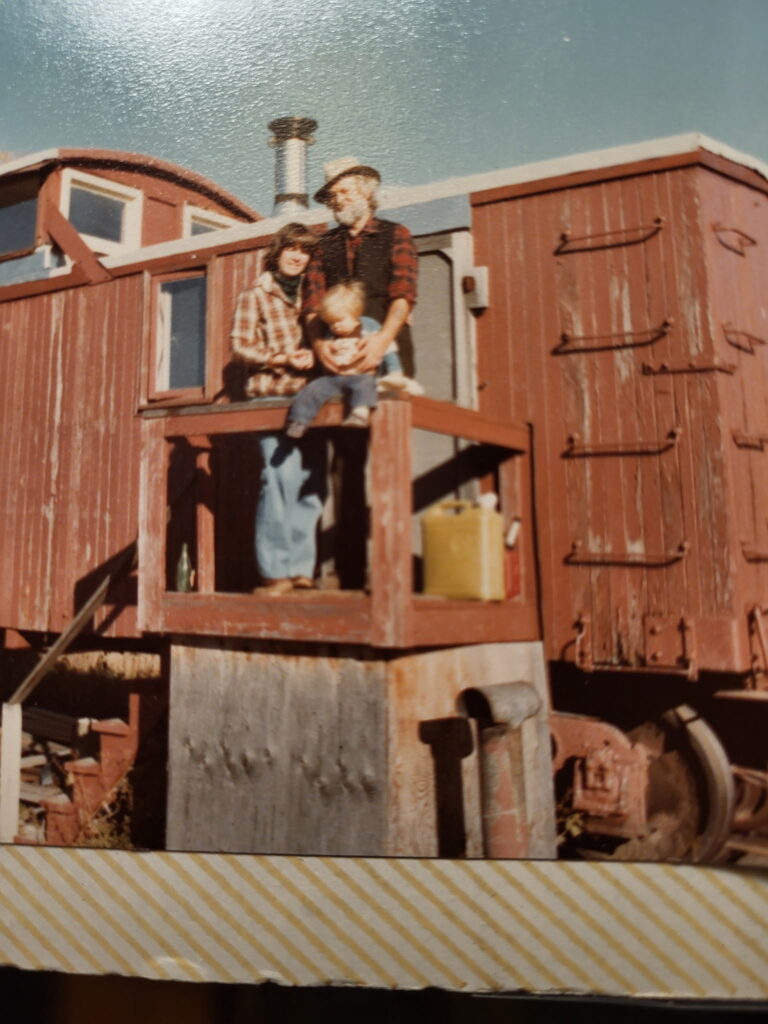
Industrial Worker recently sat down with Fellow Worker Brendan Phillips, son of famous musician and labor activist Utah Phillips, to discuss the Utah Phillips Caboose and Library. Fellow Workers everywhere are widely familiar with Utah Phillips’ music and contributions to the IWW, but they may not know that he once lived in a railcar.
When Utah Phillips was recording in Harrisburg, Vermont, the studio was “a big old white barn and it had a recording studio inside of it. He was working on records and realized that he’d be there pretty frequently, so he wanted a place to hold up. He purchased a railcar from the Central Vermont Railway. It was a flanger car, which is a car like a caboose except it had those blades on it to clear rust, snow, and ice.”
When Brendan was first born in 1977, the whole family sometimes lived in the flanger. Eventually, Utah stopped going there as much, and the railcar ended up staying on that property.
Brendan says, “Long story short, the record company sold and the new guy who owned the property was Charlie Pilser. He reached out to my brother Duncan and said, ‘Hey, I think I got your dad’s railcar, this flanger, on my property. I’m either going to sell it—or do you want it?”
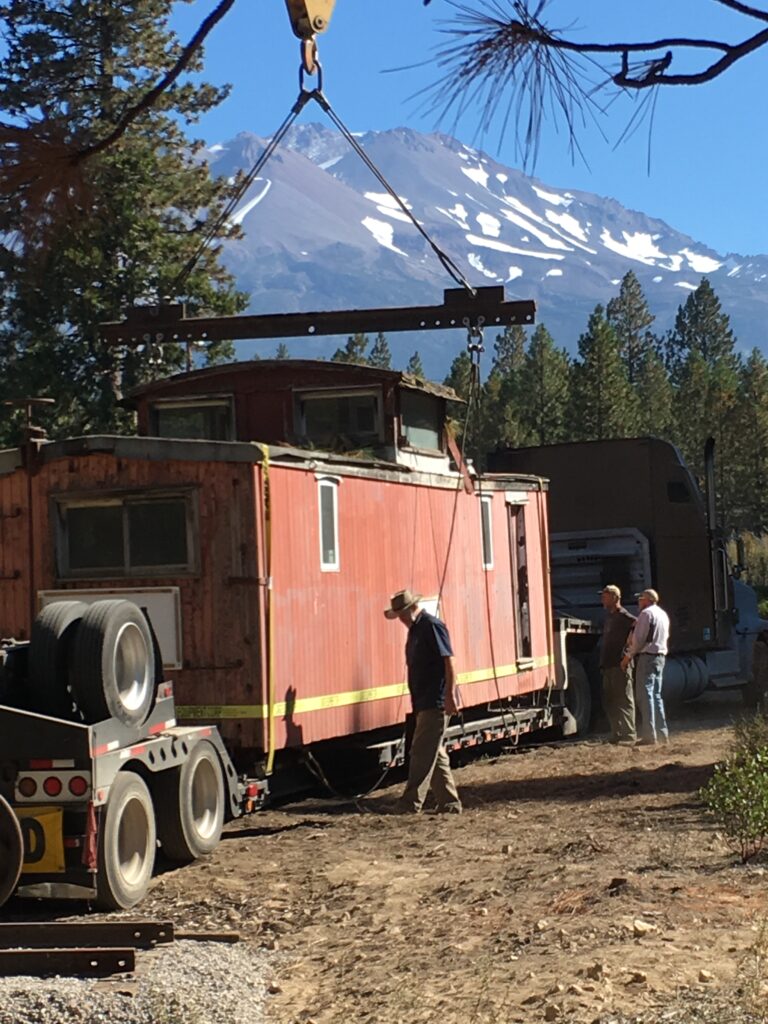
Charlie Pilser donated it and then money was raised to move the railcar from Harrisburg to Weed, California, to the Black Butte Center for Railroad Culture (BBCRC), an intentional community of train riders. The BBCRC is dedicated to preserving train riding culture on over 40 acres of land—a rail junction full of restored rail cars and cabooses—along with some habitat restoration. Utah Phillip’s flanger now calls it home, too, thanks to generous donations, a crane, and a few trucks.
Brendan describes train culture in the following way: “When my dad got back from Korea under a considerable amount of distress like a lot of people who fought in wars will have, he travelled around and rode the rails. This led to Utah meeting Ammon Hennessy, who ran the Joe Hill House of Hospitality in Salt Lake. And Ammon was the one who just told my dad, straight out, ‘You came in singing all those songs about this beautiful country you live in. It’s not the country you hate. It’s the state. You got to get it straight.”
“The trains one way or another rode him into his career and his understanding of what was going on in the world that needed to change. He was brought on by Ammon to put himself on the line as an activist, songwriter, and singer to tell stories and sing songs about working people and about the struggle,” Brendan elaborates.
“Train riding culture at large is people who travel around, who eschew the modern capitalist notion of ‘get a job, build a family, contribute to the capitalist system.’ It’s people who find work on the margins.” Instead of merely traveling to get some place, they’re also traveling for the journey, Brendan adds.
“It’s a mindset built around community and knowing people…it’s also a group of people who often have experienced serious traumas in their lives…it’s a lot of hard luck stories but it’s also a lot of finding solace in the country you live in. Understanding that you can have a life and live a beautiful life without being connected to the profit motive.”
Besides being an homage to train riders and hoboes, the railcar will serve as a space for Utah Phillips’ private papers and books. Brendan also hopes to transform it into a residence space for artists and writers.
Brendan says, “This project is about the long memory, which my dad called the most radical idea in America. His notion and something I ascribe to wholeheartedly is that we have this long river of people who came before us.” The way Brendan describes it, our ancestors contributed to the river, and when we need something, we can go down to it and pull from it and create what we need and then put it back in the river so that the next group of people who need that understanding can use it as well. The long memory “unites the movement together and it comes from decades of organizing.”
“We are at a precipice. I think that everyone knows that we are at a place as a movement where new ideas pulled from the old need to be explored in community and pushed forward. And so the library will be a nexus for that. We’re going to do an artisan residence process. So, people will be able to petition to come to the library and stay in it.”
“You’ll be able to go to the library, immerse yourself in it, drink a cup of coffee in the morning, cook yourself a dinner at night, invite people in to sit around the fire. All of that is going to be there.”
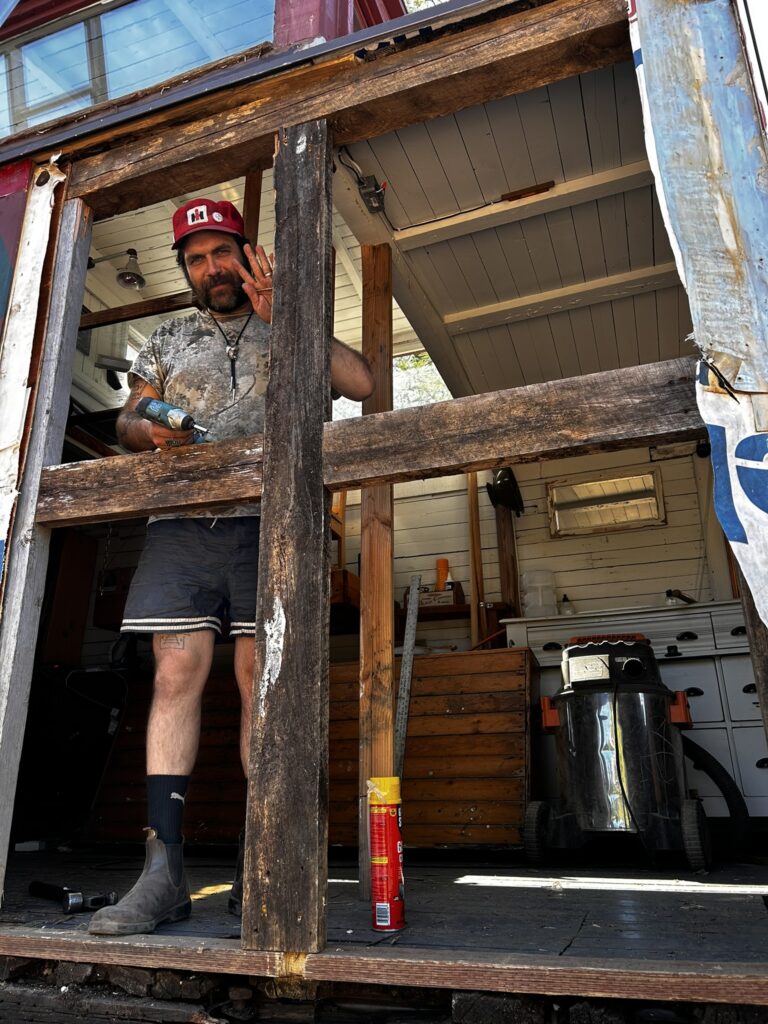
But the library can’t open without significant repairs and renovations to the deteriorated railcar. After all, it’s 120 years old and has been exposed to the elements throughout that time. For the railcar to preserve its precious cargo of historical papers and books, there needs to be structural changes, fixes, rot removal, painting, and even some electrical upgrades to ensure it can be lived in comfortably. To support Brendan’s off-grid intentions, high-voltage solar power will be needed for basic appliances.
“The main thing is that the cupola needs to be rebuilt entirely.” A cupola is the telltale part of a caboose that projects out of the top that people can look out of. With the flanger’s lengthwise support beams rotting in some places, the railcar must be lifted before a new framing system with new header beams can be rebuilt to support the weight of the cupola.
“The damage in the interior came from the leaks from the cupola, which was collapsing.” Brendan plans on replacing all of that–adding a moisture barrier, insulation, and new double-paned windows to protect the precious cargo of books and papers from the elements.
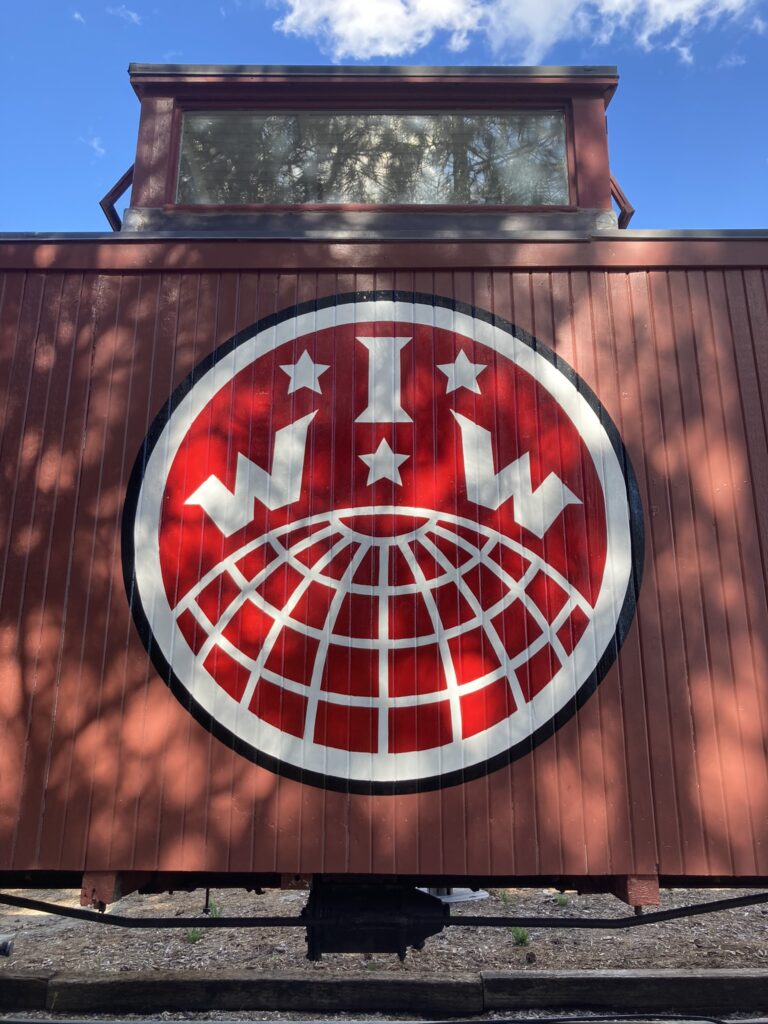
He also plans on performing cosmetic upgrades. “We had painted this beautiful IWW [mural] on the side of it. We will have to get the sign painters back out who did that…they’re very skilled at what they do.” The original mural painters have already informed Brendan that it needs to be repainted so that it lasts. He also wants to add a landing and a deck.
They anticipate a lot of labor to complete this ambitious project. The Utah Phillips Caboose and Library fundraiser remains active, sitting at a little over two-thirds of the way toward its goal of $60,000. Consider making a donation in honor of Utah’s Living Memory, preserving IWW history and making it available for future generations to learn from and enjoy.
Images courtesy of Brendan Phillips.
This article appeared in the 2026 May Day edition of Industrial Worker.