
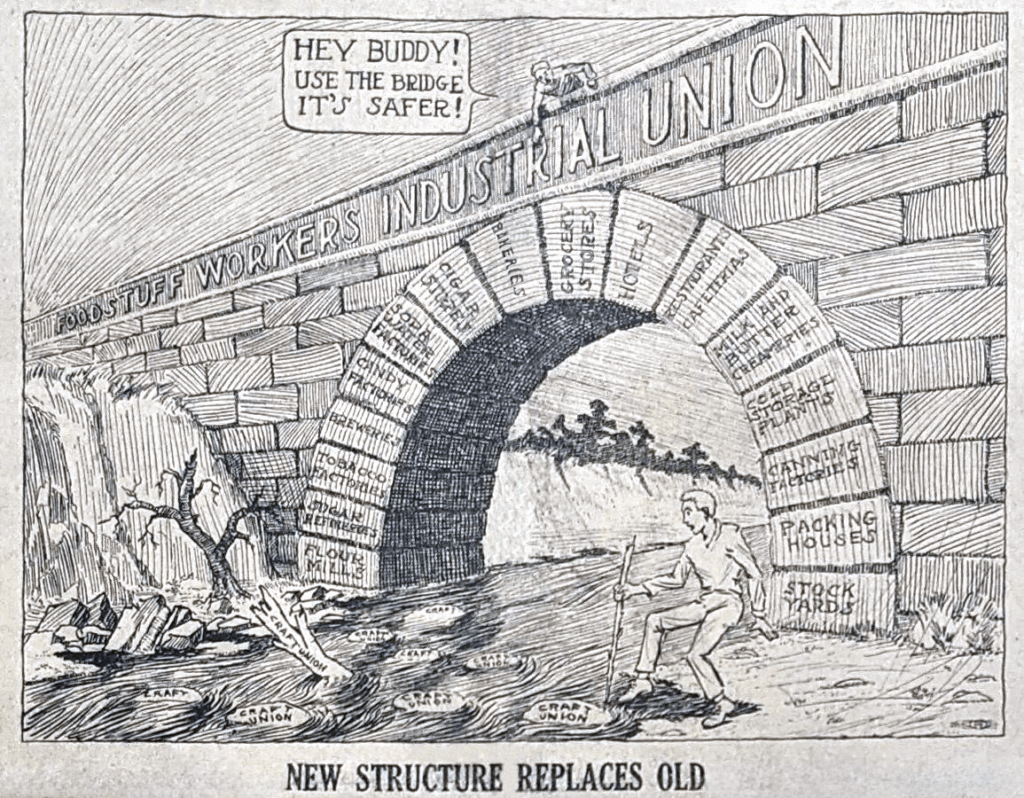
These are my observations as a dual-card steward in one of the largest unions in the U.S. while working under a contract with a no-strike clause.
The IWW’s Constitution contains a ban on no-strike clauses. Some members may recall that this ban was temporarily lifted in 2020, as a measure deemed necessary for a couple of campaigns to organize with the IWW. The membership reversed this decision the following year when it became clear that experimenting with the business unionism model had no benefit for the IWW’s approach to organizing workers toward the general strike to abolish the wage system. In practice, entertaining a no-strike clause only weakened organizing power.
Organizational drift is a concern to be taken seriously. As the IWW grows and recruits workers beaten down by weak business unionism and unfamiliar with any alternative, the idea will inevitably reappear that we can be a contract union “just like them,” but somehow radical about it, with our middle finger raised while signing collaborationist agreements that benefit employers more than workers. That illusion needs to be dismantled before it resurfaces. The IWW has never rejected contracts outright. What we reject is the contract that functions as an instrument of employer control. This should be stated plainly.
When a revolutionary union trades strike power for the promise of membership growth or media legitimacy, it creates a contradiction that begins to corrode its purpose. The central distinction separating the IWW from business unionism is simple: we refuse to sacrifice collective leverage for legal recognition. We know that whatever gains we could chase through recognition, we can win more durably through organization and class power exercised directly. Mindless contractualism creates a cycle that burns out even the best and most motivated organizers. It generally goes something like this:
- Contract bargaining is approaching, and members are starting to get fired up about making changes.
- A bargaining committee is formed. Decision-making begins to centralize. Committee members become defensive when criticized and start pressuring others to capitulate: “We might get nothing if we don’t take this offer.”
- Members get angry and feel hopeless, and some vote against the contract, but fear usually pushes it across the finish line.
- The union goes dormant until the next bargaining cycle. The angriest members stop paying dues and get representation anyway.
The experience varies based on size and structure, but a union of any demonstrable size will follow this pathway in general. Under these conditions, the strike – the only real equalizer in the workplace – is imagined as either illegal, unrealistic, or self-destructive. That mindset is exactly what the IWW exists to break. When workers learn that they can win without permission from the boss, they cultivate genuine class consciousness. That development is the foundation for rebuilding the IWW as a serious alternative to the failed strategies of business unionism.
The broader labor landscape reinforces the point. Under the AFL-CIO’s disastrous leadership of the labor movement, union density in the United States has reached its lowest point. Business union leaders like Shawn Fain and Sean O’Brien align themselves with one political party or another and court the favor of the ruling class. At the same time, workers are laid off and treated without dignity on the shop floor. No-strike clauses fit neatly into their model because they remove the one tool that would place employers under workers’ command.
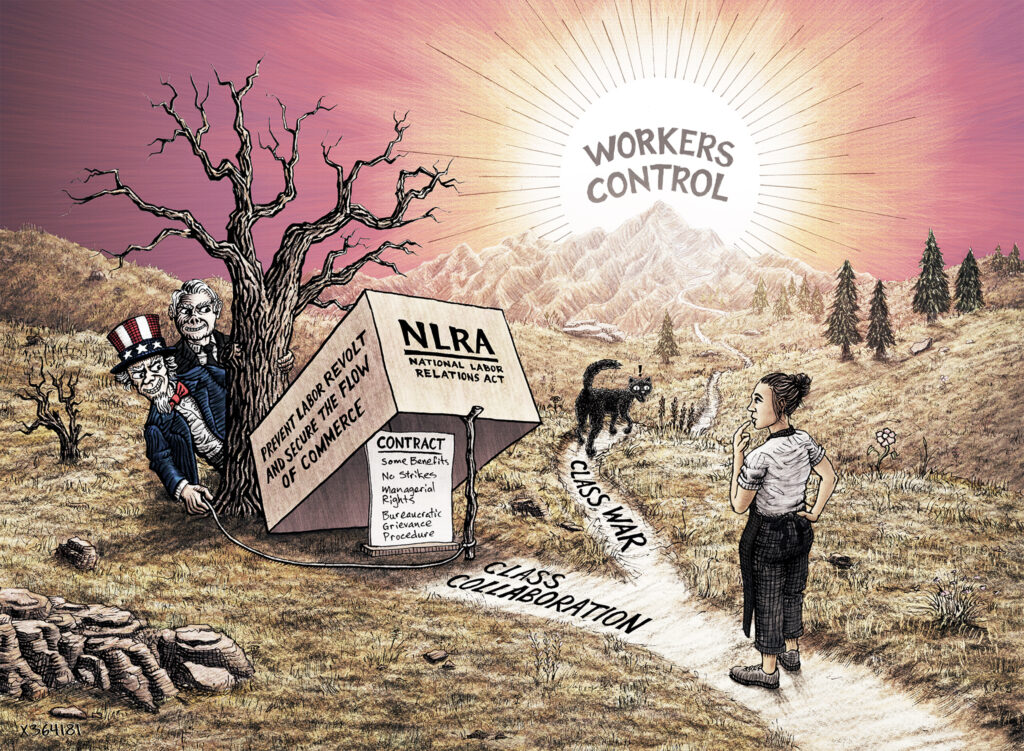
The working class has arrived at a fork in the road, as exemplified in the cover art and text of the Industrial Worker article titled “Contracts are not Class Struggle.” The first path is one of collaboration. It will mean incremental gains for individuals while the capitalist system dominates. Billionaires are already preparing their rocket ships for Mars after they finish tearing through our planet and our class.
The second path is one of class consciousness. It will mean that workers put themselves aside as individuals in favor of the collective organization of the working class to overthrow the bloodthirsty capitalist system and create a new society in which all people can live with dignity, not just the few who have all the good things in life.
This decision starts on the shop floor, no matter how small. A no-strike clause is a step toward a path of collaboration with the ruling class in exchange for a few more dollars and an extra day off. Resisting that temptation in favor of doing the harder work – one-on-ones, social mapping, democratic meetings, sociopolitical education – is a step in the direction of class consciousness.
Disclaimer: The opinions expressed in this article are those of the author. They do not purport to represent that of the IWW or Industrial Worker as a whole.