Report back from an IWW delegation to the 2025 Union Co op symposium
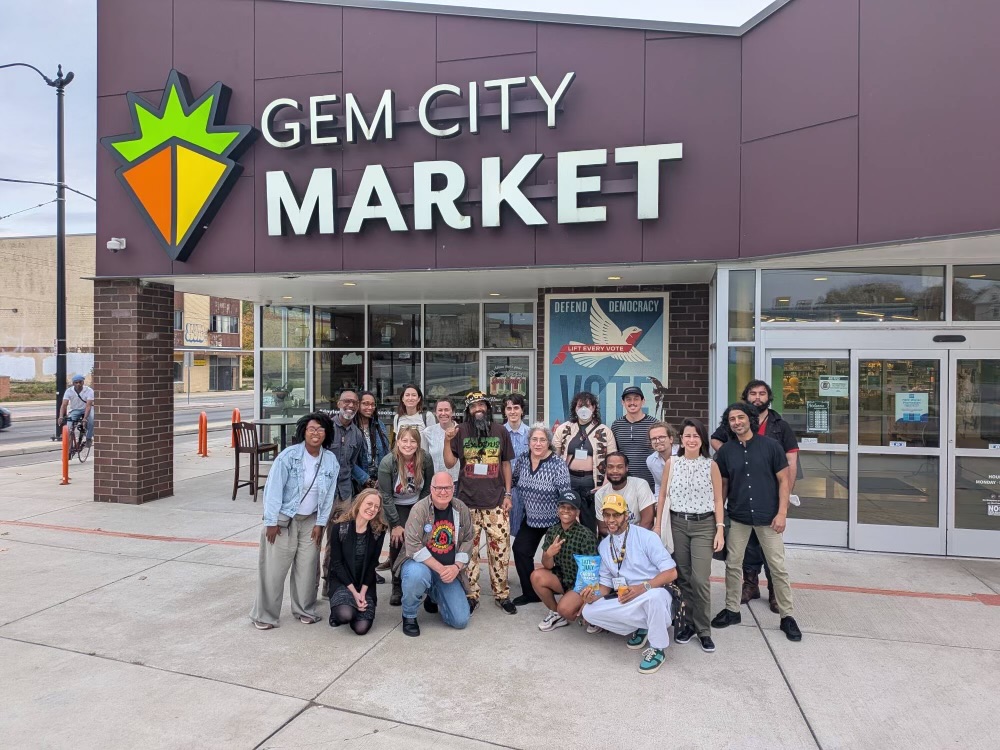
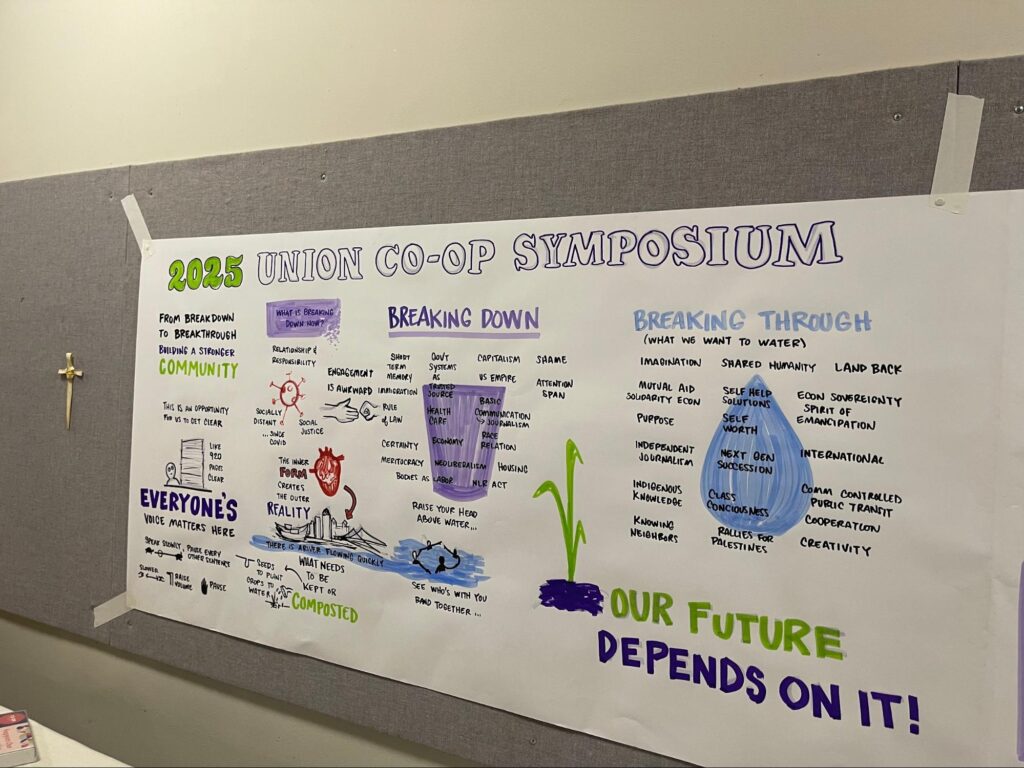
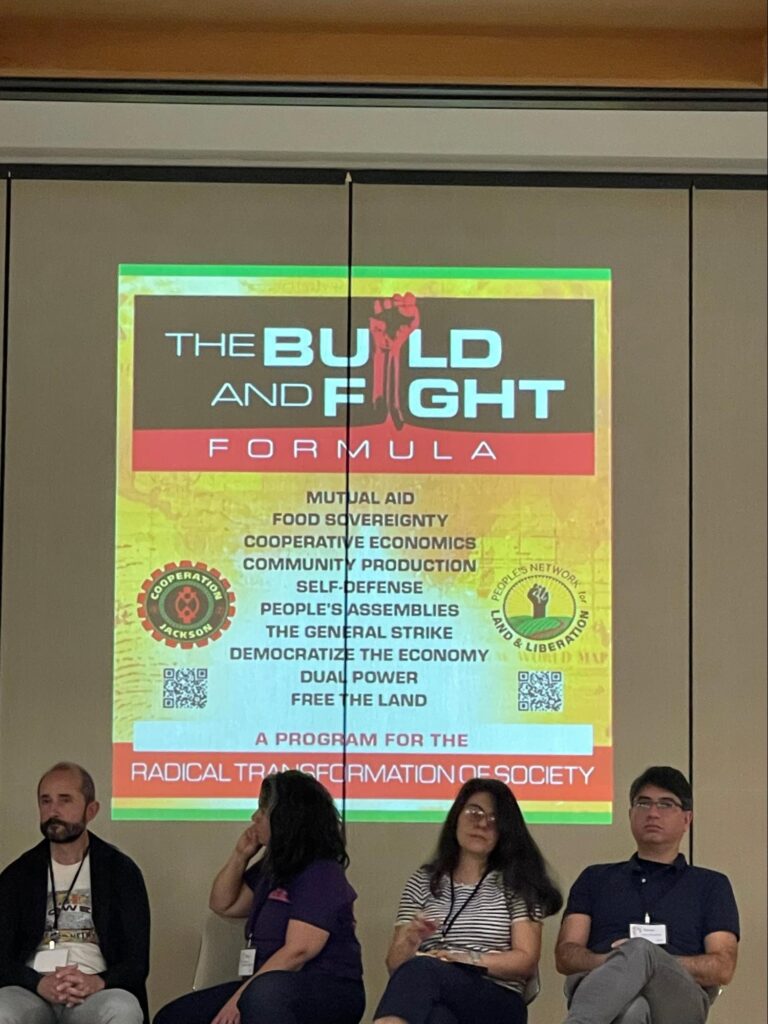
CINCINNATI, OH–Both the Pittsburgh and DC General Membership Branches formed a delegation of Wobblies organizing in the cooperative space, both as the Agricultural Organizing Workers Committee and with IWW food industry workers to head to the recent Union-Co-op Symposium, hosted by Co-op Cincy in Cincinnati, Ohio. For two days, members of the US Cooperative scene, international cooperators, union organizers, and other members of the labor community met to compare notes and talk about the collaboration of labor and cooperative organizing. The themes involved surviving the climate, the economic and political crises facing us in 2025 and beyond, as well as exploring what building a solidarity economy out of the ashes of these crises could look like. During the conference, there were a number of workshops, panels, and events, including ones on conflict resolution, collective governance, participatory budgeting, healthcare and cooperatives, labor/co-op law, housing and land access co-ops, anti-authoritarian struggle, union contracts, and more, of course, on union worker cooperatives.
The question of unions and co-ops has often been discussed both within the IWW as well as in other unions and leftist spaces. This merger of organizing tactics seems to be reemergent and slowly integrating its way into today’s labor discourse. As Jessica Gordan Nembhard remarks in her book Collective Courage: A History of African American Cooperative Economic Thought and Practice, “The story of the African American cooperative movement in the US is also a story of unionization” (pg 48). She remarked in a 2024 interview for the Everything co op podcast that we are currently entering a 4th wave of development of cooperative thought and practice, which is again deeply tied with labor struggles. In light of this 4th wave, the resurgent interest in workers’ self-governance and workplace autonomy has reemerged with it. The concept of the Solidarity Economy similarly harkens back to very socialist or syndicalist-aligned ideas of worker cooperation and management of the means of production.
A major distinction made during a keynote panel, Navigating Authoritarianism while Building the Social Solidarity Economy by Emily Kawano of the Solidarity Economy Network, was between fighting for a social economy vs a solidarity economy. A social economy seeks to reform capitalism, an almost Keynesian New Deal style, where the state moderates the worst abuses of capitalism and provides social welfare. A solidarity economy, on the other hand, is not about reforming capitalism, which is creating and perpetuating an economic system damaging to the planet and people; it is explicitly anti-capitalist and argues we must transform the economic and political system to one of deep democracy, especially in the workplace, land, and resources. Where the values are not based on individualism, competition, monoculture, and maximizing growth and profit, but rather cooperation, diversity, equity, and solidarity, that is deeply democratic, for people and the planet.
While the solidarity economy was a major point of discussion at the conference, this is an area where we noticed a contradiction for business unions that looks to be just under the surface of discussion. The dominant paradigm in the US labor movement is one that was based on the social economy ideas of New Deal Keynesian economic thought, with labor unions on one side, capitalists and corporations on the other, with the state as a neutral mediator via NLRB, and that this would moderate the worst abuses of capitalism. Business unions like those in the AFL-CIO rely on a system under the National Labor Relations Act where they become the sole bargaining agent on behalf of the workers in a workplace, and the staff who bargain these contracts are paid through a bargaining dues check-off that goes from the employer to the union, which is used to pay staff and for other similar programs. With all of this in mind, it is the Contract Bargaining Agreement (CBA) that stands out as a place where unions, as defined by business unions, are expected to interface with co-ops. We were glad we, as members of the IWW, were able to add some more nuance to defining what unions and what union worker co-ops could look like, and that it didn’t have to totally be structured around a CBA.
Much of the information provided on the matter of the union contract came from one of the sponsors of the event, the United Steelworkers (USW). While advocating for an atypical collective bargaining agreement, where worker owners are distinguished from an often elected management of some kind, the main reason for sourcing these contracts with unions like USW came down to 2 main reasons. One was to speak plainly, healthcare. USW has a healthcare network attached to many of their current shops, funded through the union itself. The second, however, is something less capital-intensive, a cooperative council. The council model within USW is similar to the IWW idea of organizing across an industry. Workers from different employers but within the same industry meet through the union to compare contracts, industry standards, and collaborate in organizing around setting those standards. In the Co-op Council of various union cooperatives under the USW, acting as a Central Labor Council like the AFL-CIO. Because of these two factors, USW District 1 (Ohio) has a number of these cooperative shops in its union structure, something still relatively unique within the broader USW structure.
From our IWW-based perspective, a critical flaw to be found in this system of course runs back down to the maintenance of labor peace under the National Labor Relations Board (NLRB). The labor peace agreement between employers and business unions, particularly during the life of a CBA, typically includes no strike, no lockout out and management rights clauses. This agreement was established to achieve a more stable business environment where production and profit-making are not disrupted, agreeing to avoid direct action on the shop floor, strikes, or pickets in addressing grievances and enforcing agreements. Work now, grieve later has been the widely accepted principle in labor law, under the paradigm of labor peace. The NLRB, as many Wobblies know, was already fairly flimsy protection and is currently nearly defunct, especially considering the obvious limitations it creates on organizing, namely through Taft-Hartley. Not only that, but the limitations found in the lack of ambition towards more transformative policy around the economic reality of the US, which many business unions have, including USW.
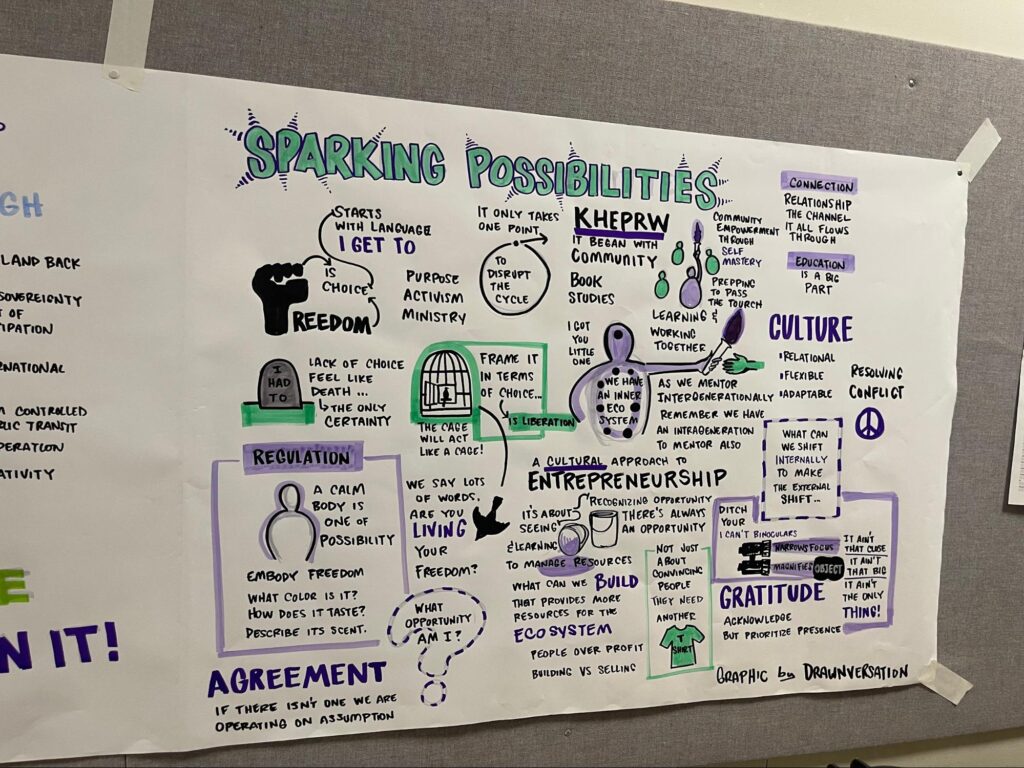
It seems that for many in the cooperative movement, the motivation is based in the development of the solidarity economy, a transformative measure to move beyond the capitalist system and the wage system. When talking about these and other distinctions with people from the cooperative movement, we find that many of their values aligned deeply with those of the IWW, and there was a desire to connect with and collaborate with IWW branches on organizing and educational projects. We, as IWW members, can also strongly learn and benefit from working with these cooperators in learning methods for worker control and ownership within the workplace, including on topics of: participatory budgeting, converting workplaces from private ownership to worker ownership, and more. We could go on for pages about all we learned and did, and encourage FWs to view the symposium agenda, notes, and photos we took for a more comprehensive report on what was learned.
We met a lot of great people and learned a lot, and engaged in some excellent discussions around these ideas and more. The next Co-op Cincy Union co op symposium will be in 2027, and we encourage other IWW members to join us in a delegation to the next one. In the meantime, if you wish to collaborate on the creation of an IWW co-op council to compare notes on organizing new worker co-ops, converting private businesses to co-ops, connecting to cooperators in your area, or something co-op related, we can start with a Signal chat. Please email either the Pittsburgh or DC GMBs with the subject line IWW Co op Council and let us know where you’re coming from. We can connect and add you to the Signal chat.
In solidarity, Fellow Workers.
Disclaimer: The opinions expressed in this article are those of the author. They do not purport to represent that of the IWW or Industrial Worker as a whole.