

Too Many Coincidences
“In the end, the only people left in the organization were the autistic folks. We held the movement together by taking on all the tasks. But it wasn’t enough…”
That is not how I thought Occupy Austin would end. But that is how my coworker Maurice described it, having been at the core of the movement in its prime and in its last days.
“All the neurotypicals ran out of motivation, or free time so we were the only ones left. It was too much work and I felt abandoned. That’s why I don’t organize anymore. I burnt out hard. I never want to go through that again.”
That was the day when Maurice rejected my offer to join an organizing committee. And I was left with a terrible doubt: What if the same fate awaits the IWW? What if it awaits me?
After that conversation, I started to see a pattern. A fellow officer mentioned taking ADHD meds. Another casually said she was on the spectrum. I started to notice the neurotypical officers coming to meetings and events less and less.
Then, the 2021 membership survey report showed that neurodivergent IWW members are twice as numerous in the union as they are in the general population. But why? The same report showed that most minorities are under-represented in the IWW. Why are neurodivergents over-represented? A chill went down my spine when I saw the similarity with Occupy Austin’s downfall.
I was developing a theory: One of the symptoms of autism is called “justice sensitivity”. It makes many of us more emotional in situations of unfairness. I believe this symptom explains the large percentage of neurodivergent members who are active enough to fill out the survey. I believe “justice sensitivity” makes it easier to agitate us using AEIOU skills, or for us to self agitate. I believe it also makes us more likely to stay invested in a cause for longer, especially if the cause becomes a hyperfixation or a special interest like the IWW is for me.
But confirmation bias is a powerful thing and I didn’t want to reach any conclusion that wasn’t supported by data. So, I joined the Survey and Research Committee and analyzed the data available in our recent membership surveys. They contained questions about whether the respondent was neurotypical or neurodivergent. And I was able to compare how the two groups answered the other questions.
Please be aware that the data only shows the answers of IWW members who took the time to fill out the survey. The numbers are skewed towards members who are more likely to be active in the union and doing tasks, such as this survey.
In 2021, 38 percent of the respondents self identified as neurodivergent. In 2025, it was 43 percent. In comparison, a reasonable estimate of all neurominorities within the population is around 15–20 percent.
This includes up to 10 percent of people with dyslexia, 6 percent with dyspraxia, 5 percent with ADHD, and 1–2 percent with autism.
The survey unfortunately didn’t ask which type of neurodiversity each respondent had. So we don’t have the data to conclude that there is a disproportionate number of autistic people in the union compared to the average population. All I have to support that theory is my personal experience asking active members of the union. But the data does show we have twice as many neurodivergent people active in the union as there are in the average population.
When we look at membership demographics like that, there are two factors that can explain who is in the union. Recruitment, and retention: Who joins and who stays. So either we recruit a disproportionate number of neurodivergent folks, or the ones who join, stay active longer than neurotypical folks. Or both.
There is also the possibility that neurodivergent folks are more prone to filling out surveys than neurotypical folks. However, I haven’t found studies that support or disprove this option. We will assume moving forward that only recruitment and retention have an impact on membership percentages.
Member Retention
The graph below shows the length of membership of survey respondents in 2021. For the first 9 years, the numbers are similar. Neurodivergents and neurotypicals leave at similar rates each year… Until memberships that last for 10 years or more. Beyond that point, neurodivergents are 6 times more likely to still be in the union and answering surveys. For some reason, the neurodivergents who stick around more than 10 years are in it for the long term. I believe that is because the union itself is a lifelong special interest for some neurodivergents and that makes it easier to stick around: Union work is more fulfilling than it is for neurotypicals, or neurodivergents who don’t have the union as a special interest.
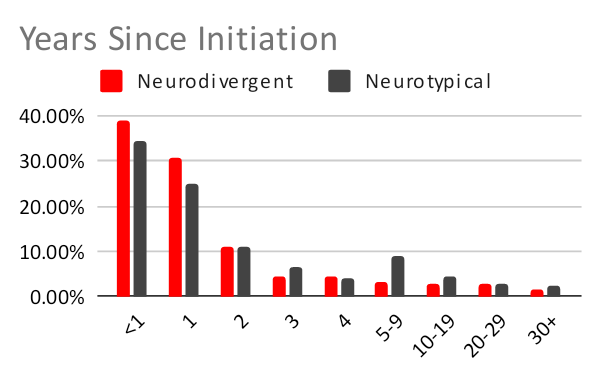
Overall, the retention numbers are very similar. Neurodivergents are 11 percent more likely to leave in the first few years, which should pull down the percentage of neurodivergents in the IWW population.
So the higher than average numbers of neurodivergent folks can probably be explained by a higher recruitment rate of neurodivergents.*
Recruitment of New Members
The survey only asked how respondents had first heard of the IWW, not the reason why they joined. This means we can only theorize as to why we are so much better at recruiting neurodivergents.
But it shows us where we could apply efforts to recruit members:
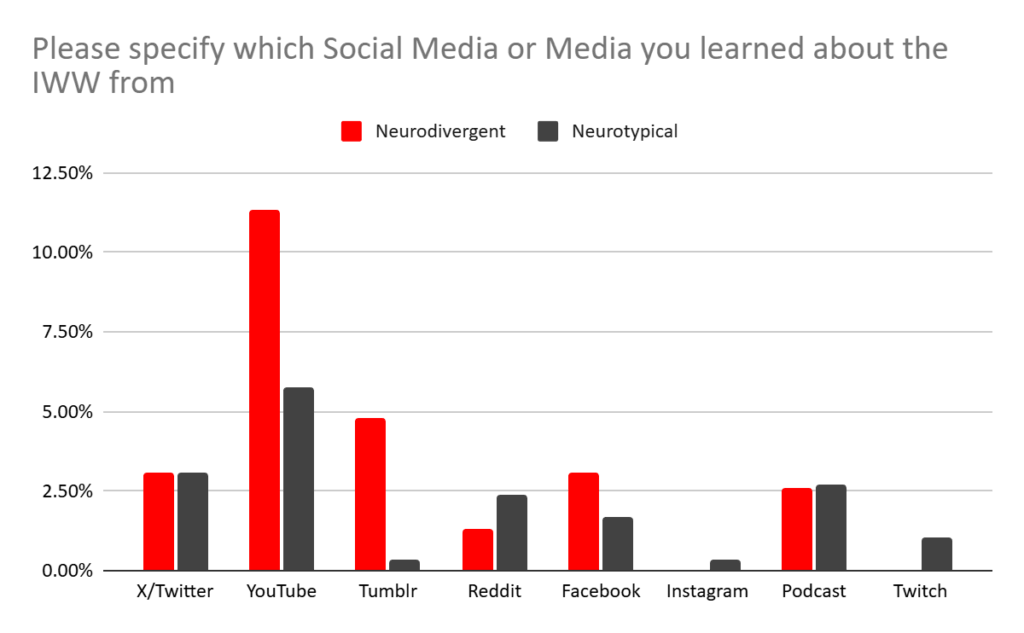
Neurotypicals are more likely to find the IWW through media like songs and books, history, and web searches. Neurodivergents are twice as likely to find the union through social media or Youtube.

Participation in union activities:
Last month, I was a trainer on an OT101. I asked the participants to raise their hands if they identified as neurodivergent. Out of the 15 trainees, 10 raised their hands and they were the folks who had been most active during the training. All 3 trainers raised their hands. I thought that surely, this pointed towards more participation in union work than neurotypicals! But the surveys show that it’s not clear cut, depending on which task/officer position is looked at.
When comparing survey responses, I found that most of the questions were answered similarly by both neurotypicals and neurodivergents. Minor trends did emerge when it comes to participation, appreciation of certain IWW resources, and feelings of belonging.
Neurotypicals are more likely to have filled the roles of chair, co-chair, note taker, or time-keeper in branch meetings. They are also more likely to have added an agenda item to branch meetings (15%), more likely to be serving on branch committees (2%), or in officer positions (6%). Neurotypicals are also more likely to be dual carding with another union in the workplace (15%), to have experience as an external organizer (7%) and to have more than one person on their workplace organizing committee (7%).
In 2021, neurodivergents are 10 percent less likely to be actively organizing their workplace, but in 2025 they are 10 percent more likely to.
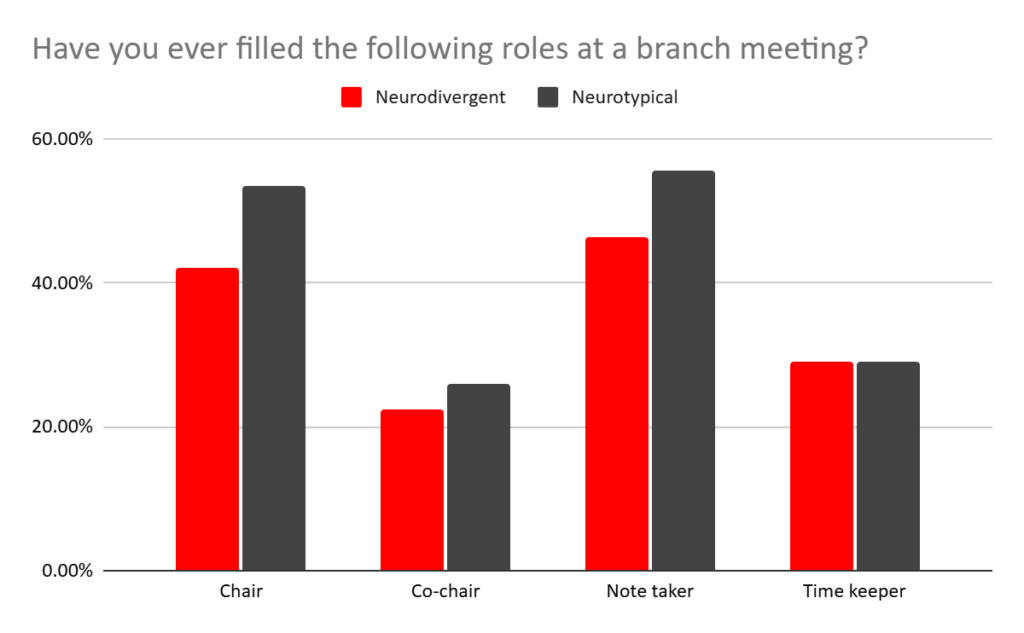
This is good news for us in the long term. If the model of a dying movement Maurice proposed is typical, then we haven’t reached the end stages where neurodivergents are taking on most of the responsibilities.
It’s also interesting that a group who takes on less tasks or positions in the union sticks around for the long term, as we saw in the previous section. This might be because pacing oneself in organizing helps prevent burnout. See my previous article on burnout in the union: Burnout at the stake.
Appreciation of the Union’s Resources
Neurodivergent people report more difficulty finding organizing resources, which is surprising because they also report having access to resources more often than neurotypicals. For example, neurodivergents report attending an OT101 11 percent more often than neurotypicals. They also report having an organizing mentor 11 percent more often and to find them more useful.
Neurodivergents report having access to contacts in their local branch 5 percent more often.
Neurotypicals find media, communications and outreach training useful 11 percent more often.
Neurotypicals find OT101s and OT102s less useful than neurodivergents do and find support from the ODB useful 12 percent less often than neurodivergents.
Neurodivergents report feeling less support from the union and local branches. Neurodivergents also report that the work they do in the union makes their fellow workers proud of them less often. They are also less proud of their own work.
Neurodivergents are more likely to report facing the following barriers to organizing:
- Unsure of what to do next
- New to the job
- Do not feel comfortable talking to coworkers
- Difficulty getting coworkers’ contact info
- Fear of retaliation
- Not planning to keep this job
Neurodivergents are less likely to think the dues they pay are worth it for the resources the IWW provides, and less likely to see the union as a community of like-minded people. And they are also less likely to advise friends and co-workers to join the IWW.
But Do We Feel Like We Belong?
Neurodivergents report less confidence in the union’s future, less ease accessing union spaces, less feelings of safety in union spaces and more desire to focus on establishing safe spaces within the union.
That is consistent with other minorities being less satisfied than majorities with the IWW’s efforts to make them feel welcome and safe.
Conclusion and Recommendations
In summary, we see that our current recruitment methods are more likely to bring in neurodivergent folks.
They then tend to be less active in the union, taking on less officer positions, participating in meetings less, and organizing their workplace less. Neurodivergent folks make more use of the resources that the union provides like OT101s and organizing mentors, and organizer trainings. They also report more satisfaction with those resources.
This might make neurodivergents feel less useful and appreciated but it also seems to prevent burnout in the long term.
So what does this mean for us? We should adapt our recruiting methods to recruit workers more broadly.. And we should find ways to keep them involved for the long run. We should make sure we are a safe space for all workers and that neurodivergent workers are able to participate as equally as neurotypical workers.
More importantly, we need to address why so few of our recruitment numbers are coming from workplace organizing. It is the next subject of my research so keep an eye out for another article.
We need to make union spaces safer and more welcoming to all minorities. Otherwise, how can we say we believe in solidarity?
Lastly, we need to get in touch with the illuminati and tell them to put more autism in the vaccines.
Disclaimer: The opinions expressed in this article are those of the author. They do not purport to represent that of the IWW or Industrial Worker as a whole.
Special thanks to x431037 for all the data crunching and graph making work that went into this article.
This article originally appeared in the 2026 Winter print edition of Industrial Worker.
*As of 2-26-2025: Graph and paragraph have been corrected from the original publication on February 12, 2026.