

The year was 2025. Austin, Texas, was hosting the Southern Regional Organizing Assembly (SROA) for the first time. Members came from all across the southern states to attend, learn about workplace organizing, and make connections with fellow workers. We were ready for 50 members to attend, as we had at the 2023 SROA, but only about 30 showed up. This was yet another sign that something was wrong with the One Big Union. And things were getting worse.
I had noted that we had fewer workplace campaigns than in previous years. Fewer members attended the general business meetings, or the monthly socials.
Even more alarming, the southern coordinating committee had lost 3 branches since 2023, and gained none. I felt like I was hearing the last gasping breaths of my beloved union.
But all was not lost. I knew that the SROA was a great place to take stock, brainstorm solutions and start to fix the problems we identified. So I prepared a presentation that took stock of where we are as a union, and how we might reach the goals we have set for ourselves.
1. Defining Our Goals
“A struggle must go on until the workers of the world organise as a class, take possession of the means of production, abolish the wage system, and live in harmony with the earth.”
Preamble to the IWW Constitution
The IWW has existed for 120 years but these ideas were already in the first preamble. The fellow workers of the past have lived by those words and done their part to make them true. Sadly, these goals have yet to be achieved. We aren’t organized as a class. We haven’t taken possession of the means of production. The wage system is proving harder to overthrow than expected. And I see less and less harmony with the earth when I seek it.
Those aspirations are what we work towards, but what’s our collective strategy? Currently, we focus on three smaller goals:
Membership growth: Our efforts focus on the efficient administrative intake of new members and advertising our organization online and offline. Once intake is done, we work to involve new members with organizing their workplaces and local projects.
Workplace organizing campaigns: We support workers directly through external organizers, strike funds, branch support and ODB reimbursement of organizing related spending
Trainings: OT101, OT102, Workshops, Power hour, Roleplays. All these trainings aim to give workers the skills to organize their workplace directly, democratically, and efficiently.
2. Membership
I started this research by reaching out to our then membership coordinator Warren and to the Survey and Research Committee. The following data is from the reports done on the 2021 and 2025 membership surveys and from the 2023 exit survey report.
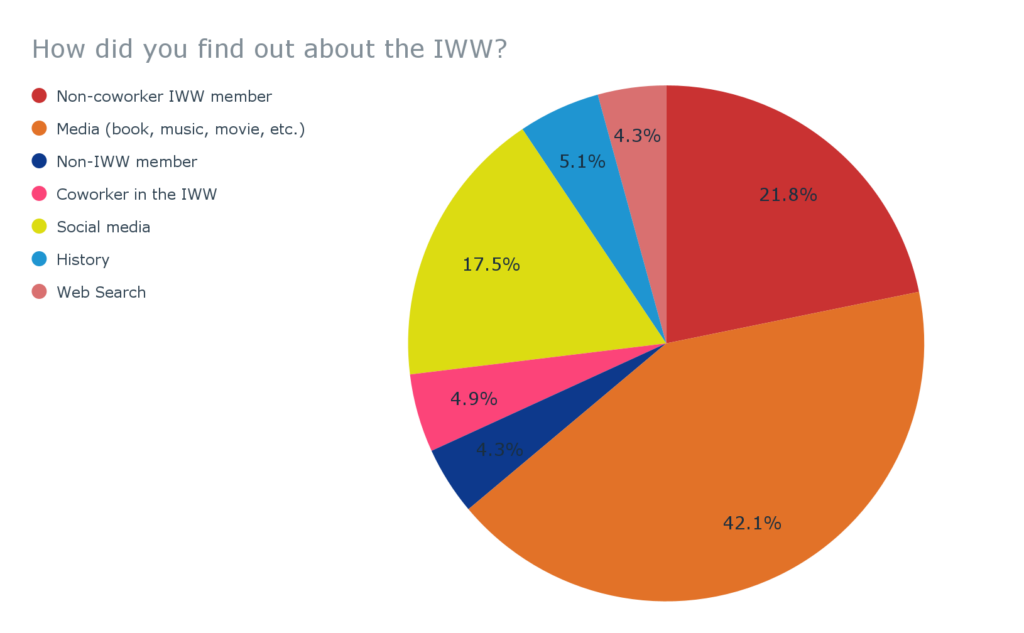
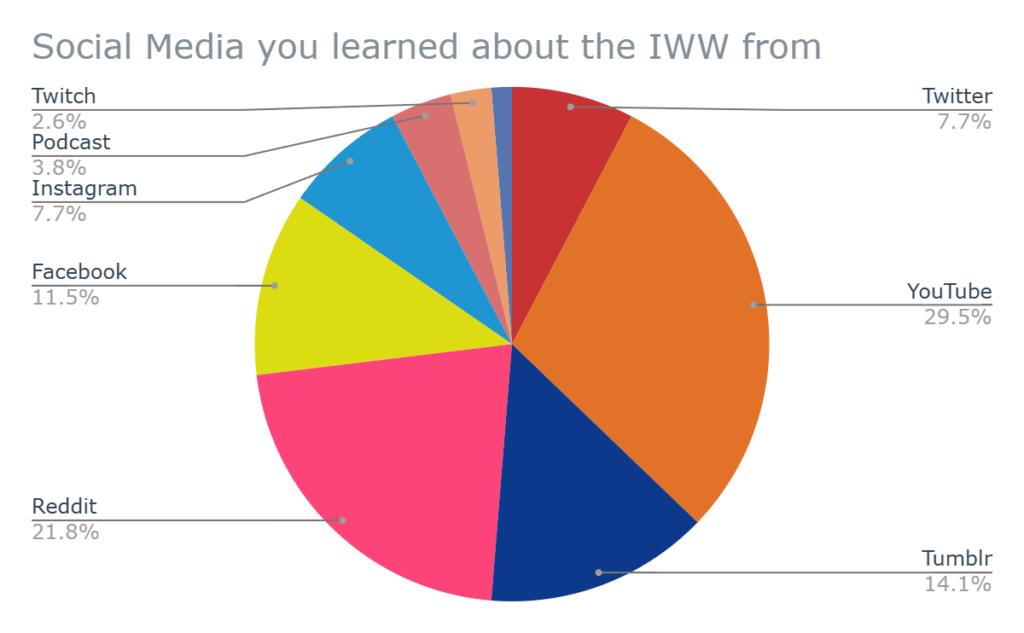
Our current strategy for growth at the branch level consists of two efforts: Maintaining our social media presence, and convincing workers to join through the efficacy of our campaigns. At the national level, we rely on word-of-mouth. Here we see that only 4.9 percent of members found us from one of their coworkers in the IWW. But the efforts we put into social media were the first exposure to the union of 17.5 percent of our membership. Which ones you may ask? Mostly Youtube, Tumblr and Reddit.
“The union has gone through extreme swings on how this [our web presence] is viewed, seemingly ranging from seeing it as one of the most important things to not mattering much at all. In my opinion […] its importance falls in the middle. A web presence in the form of an updated website and frequent, relevant social media posts may not by itself push people to actually join, but I think it does make people who are looking to join for other factors a final nudge to go through with it.”
–Former Membership Coordinator Warren (2023)
So, our efforts to grow membership are working, right? Wrong.
If you want to see real membership growth, look at the surge of new members that started in 2019 and ended in 2022.
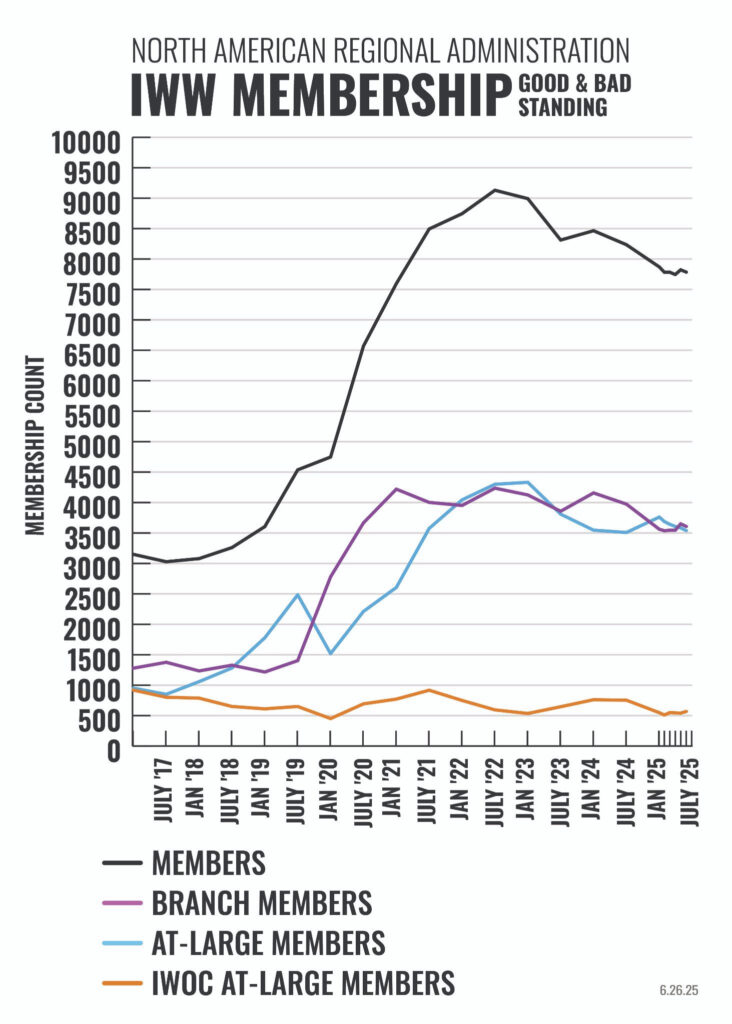
I asked our then membership coordinator about it. If we had such a successful recruitment campaign, why did we stop? The answer is disappointing to those of us who make propaganda: The surge wasn’t our doing.
“The IWW has little control over whether people join. Almost all significant membership surges correlate with events the IWW has little to no involvement in such as the 2016 US Presidential elections, the COVID shutdowns, Bernie Sanders dropping out of the 2020 Democratic Party primaries, the 2017 far-right march in Charlottesville, VA and the US Supreme Court’s ‘Janus Decision’. Put more bluntly, people join when bad things happen and they see the IWW as potentially addressing these bad things.
It is more difficult to correlate specific IWW projects with bumps in membership. It seems that often when a workplace organizing campaign goes public, there is a bump in people joining in that specific metro area. “
–Former Membership Coordinator Warren (2023, 2025)
The IWW produces a lot of art, educational content like flyers, and passionate calls to action. Yet it does not seem like those IWW projects result in noticeable membership growth, at least not noticeable on the larger scale of the NARA territory. Whatever effort we are putting in advertising the IWW, it does not compare with the impact of historical events beyond our control.
This could mean we just haven’t found the right type of propaganda to call the masses into action, or that such propaganda does not exist. On the other hand, writing union songs, drawing posters and other forms of union media production are beneficial to the one making them. It helps us relax and have fun where union work is often serious and stressful. As such, I don’t think we should stop our efforts of recruiting workers that way, but advocate for mindfulness around its efficacy.
Membership Retention
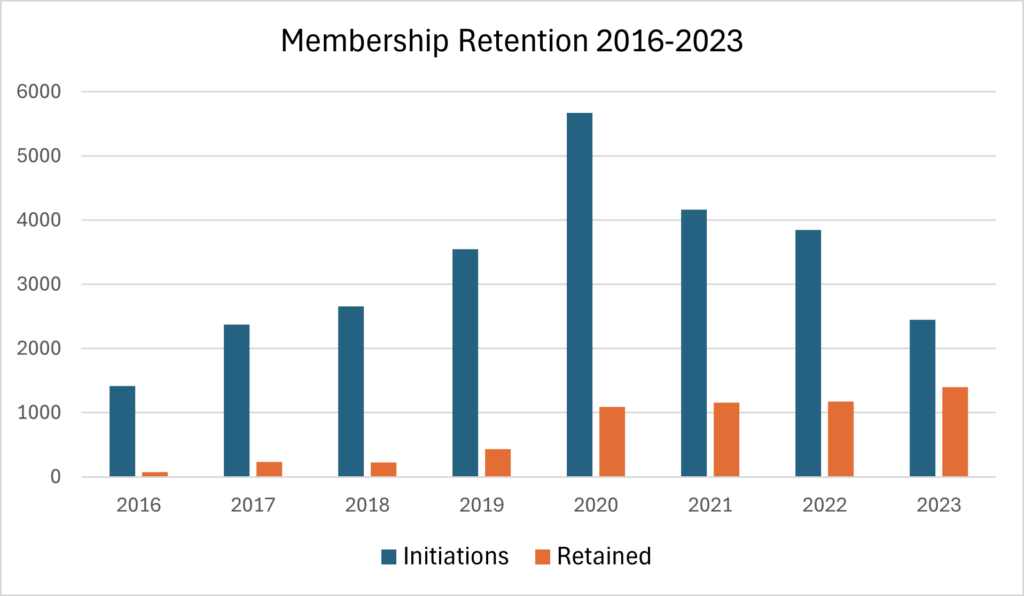
Membership retention shows us that our members don’t stay in the organization very long. In the above graph, the blue shows the number of members who joined that year. The orange shows who was still in the IWW in 2024 based on the year they joined.
We see that retention drops off quickly and surely the more time passes after a member joins. A stunning figure in the former membership coordinator’s survey is that only 35 members remain from all of those who joined before 2015. This means that we are consistently losing members and we are unable to keep any but the most tenacious for more than a decade.
As a consequence, our collective memory is relatively short because we cannot retain the members with the most experience. On the other hand, the 2025 survey report shows a disproportionate number of respondents were retired workers with a desire for more involvement. So we might still tap into our collective memory by involving those fellow workers more.
The exit survey report shows the details of why members leave the IWW and here are my takeaways:
12 percent of exiting members reported they were leaving because they had never been contacted by a branch. 29 percent had never taken part in any union activity. Not even going on the union’s forums. This shows the need for an improved onboarding process into branches, both local and industrial.
Demographics
Demographic data shows us who we are.
It shows which groups we are not reaching, or whose membership we lose consistently.
It shows the strengths and weaknesses of our growth strategy.
And from there, it might show us a better way to increase our numbers.
I recommend that you read the 2025 membership survey report for the details. In short, IWW members are most likely to be cis, white, male, aged 25-34, neurodivergent and have low income. it is worth noting that trans women and non-binary people are massively overrepresented in the IWW compared to the general population. Otherwise, the data shows that our membership is very homogeneous which can lead to flaws in our organization. For example:
- Echo chamber effects
- Lack of connection with intersectional issues
- Difficulties recruiting and retaining members from a majority of the social groups that comprise the working class.
- Workers will not feel like they are represented in the union, and in the positions of leadership.
So our current growth strategy needs to evolve. But how?
“The ideal way would be for membership to come from shops, people joining based on organizing within their structure. Otherwise we would only ever get people who are already politically activated.”
–Fellow Worker Hazel (2025)
3. Campaigns
“When it comes to campaigns, we lie to ourselves a lot. One of the campaigns in my branch lasted years. It was just a couple at their workplace. They never recruited anyone.”
–Fellow worker Anonymous
There are 3 steps of growth in a campaign. It starts as a lead with a small number of workers who are trying to unionize their workplace. It levels up when enough workers join to create an organizing committee, and again when it becomes a job branch. At that point, the campaign has its own bylaws and budget, and is partly independent of the local branch.
In the 2025 membership survey, 25 percent of our working members were organizing their workplace. Only 6.1 percent were part of an organizing committee with at least 2 members and only 1.6 percent of members were part of a job branch. This shows a mix of positive and negative signs. Our conversion rate from worker to committee and committee to branch is about a quarter (24 percent and 27 percent respectively). Unfortunately, our actual organizing participation is very low.
4. Trainings
“Going on information from 2008-2018 and 2021-2025, there have been 392 Organizer Training Programs reported to the OTC. The vast majority of these 392+ trainings are OT 101s, I do not believe the OTC has ever run more than two T4Ts per year, and OT 102s have also been put on rather infrequently.
Based on reported 2025 (OT101) trainings so far, average attendance is 11.7 people, so round to 12. Smallest training was 5, largest was 30.”
–Fellow Worker Jacob, Organizer Training Committee (2025)
Based on the OTC’s estimates, we have, over the course of 14 years, put together:
- A little more than 364 Organizer trainings 101
- up to 14 Organizer Trainings 102
- up to 14 trainings for trainers
If the average of 11.7 attendees per training in 2025 is assumed to represent the attendance in previous years then we have taught OT101 to about 4260 workers since the training was created. About 300 workers per year received OT101 training, although this does not account for members taking it multiple times.
That is quite an achievement, but it doesn’t scale well with our ambition of making “every worker an organizer.”
Efficacy of Trainings
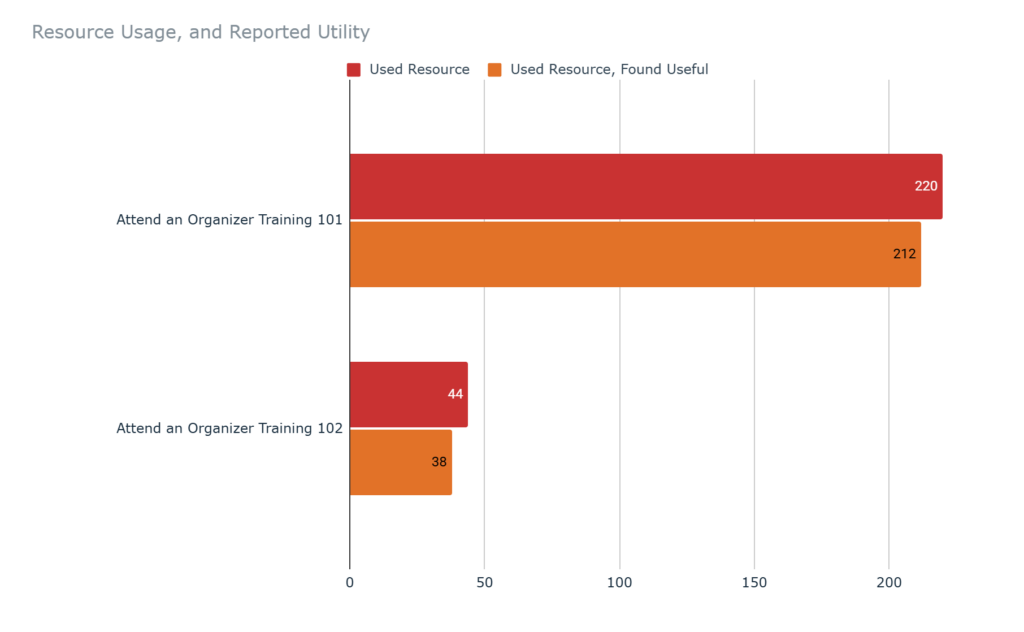
This graph shows most trainees found OT101 and OT102 useful. But the positive impressions of participants does not necessarily translate into efficacy.
So how do we evaluate the efficacy of our training? Once again, by looking at the stated objectives of OT101: Train employees to unionize their workplace safely. Trainees are taught to reach out to fellow workers, obtain means to contact them outside of the workplace, and understand ways to protect themself and others from retaliation. The below chart comes from 2025 survey data around resource use and several common barriers to workplace organizing that our trainings aim to address. It shows how using a resource impacts how often members report facing those barriers.
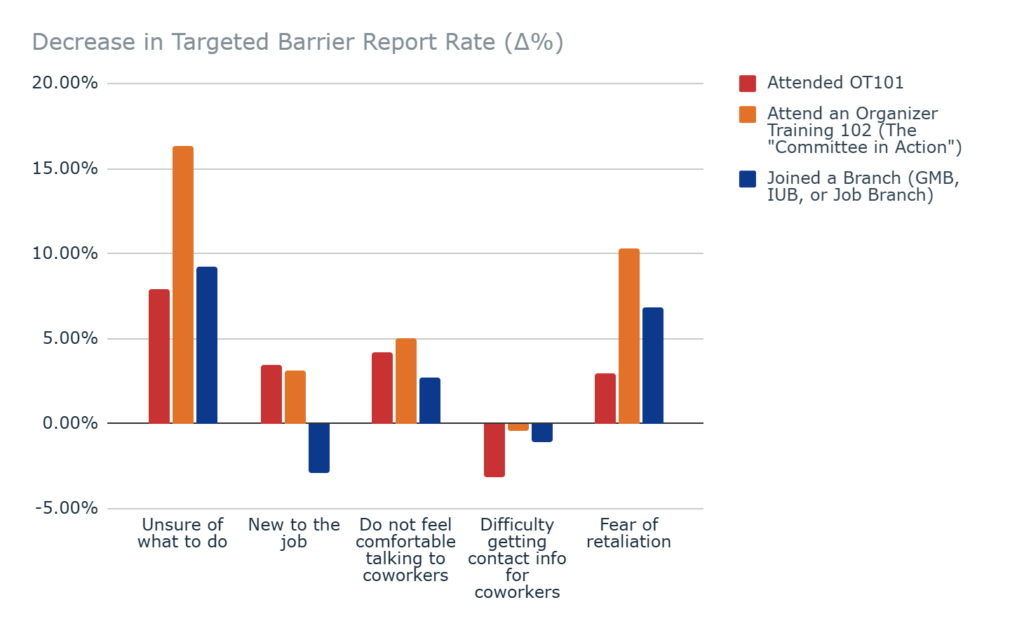
As we can see, training attendance does seem to generally correlate with a reduction in reported barriers. The exception here is in “Obtaining contact info for coworkers,” but this may be a reflection of higher attempts. It is worth noting, however, that the improvements here for OT101 do not vary substantially from those of joining a branch, and while only in 2025 29 percent of branch members have taken an OT 101, 81 percent of OT101 participants are members of a branch.
So training looks effective, but it’s difficult to separate it from branch membership.
5. Potential Solutions
Back to the 2025 SROA. I had come up with multiple potential solutions to our problems. I would run those solutions by the attendants and we would choose a couple to focus on moving forward. I suggested that we make a Youtube series about workplace organizing with all the content of OT101 to create a version of the training that would scale better. Attendees pointed out we didn’t have the budget to gamble on such an undertaking.
I suggested we allow donations, and make the lowest a member could pay in dues a mere 1 cent. Attendees pointed out that the administrative cost of each member was too expensive to try to run the union that way.
I suggested that we create a new religious system called “syndicatism” so that workers could skip work to attend union meetings and trainings under the protection of “religious exemption.” Attendees liked the idea but none have converted so far.
In short, my ideas weren’t going to save the union. But another idea will. The best solution had already been revealed to the assembly 30 minutes before my presentation by fellow worker Glenn. He had also shared this idea when I did the training for trainers with him. And every time I’ve seen him. And yet it hadn’t gotten through my thick skull until this year. The solution is for you to focus on organizing your own workplace by the book. No excuses.
“There are no magic solutions.”
–Fellow worker Glenn
Fellow worker Tim has been pointing out for years that very few members of the IWW are actually organizing their workplace, even those who took OT101. Only 25 percent of us when we aim for 100 percent.
In my time at the Austin branch, I’ve asked many FWs if they were interested in organizing their workplace. Each answer was different, because each workplace is different. But, strangely enough, these answers all start the same way: “I just don’t think it would work in my workplace.” Seasoned external organizers and trainers have said that. These are the folks who know the most about workplace organizing. I’ve said that. I have been an OT101 trainer for almost 3 years now so I know everything we teach on workplace organizing by rote. But when I had started organizing at my workplace, I skipped some steps, encountered a couple of rejections and gave up. I didn’t do it by the book and my failures sapped all my motivation. We are very much lacking in confidence in the union and that translates to very few campaigns when we need campaigns in every workplace.
Shortly after the SROA ended, I started organizing my work again. Exactly the way we are taught in OT101 (including the very important step of asking for help from my branch). And it worked! I now have 2 coworkers on board, a social chart that takes up a whole wall in my apartment, and hope. Organizing my own workplace has also revitalized my branch a little bit. I asked other trainers and external organizers for help, advice, and practice roleplays, something we don’t do enough after taking an OT101 in my opinion. The involvement of these organizers re-energized them into action. One such EO even started organizing her own workplace!
Previously, I thought that the most I could do for the union was to be a branch officer, an external organizer and a branch trainer. Now, I’m not so sure. Now, I feel that my efforts are better spent focusing on organizing my own place of work.
I know you have reservations and doubts about organizing at your work. We all do. But that’s what the IWW was made for. So let’s return to our roots together.
Disclaimer: The opinions expressed in this article are those of the author. They do not purport to represent that of the IWW or Industrial Worker as a whole.
This article appeared in the 2026 May Day edition of Industrial Worker.