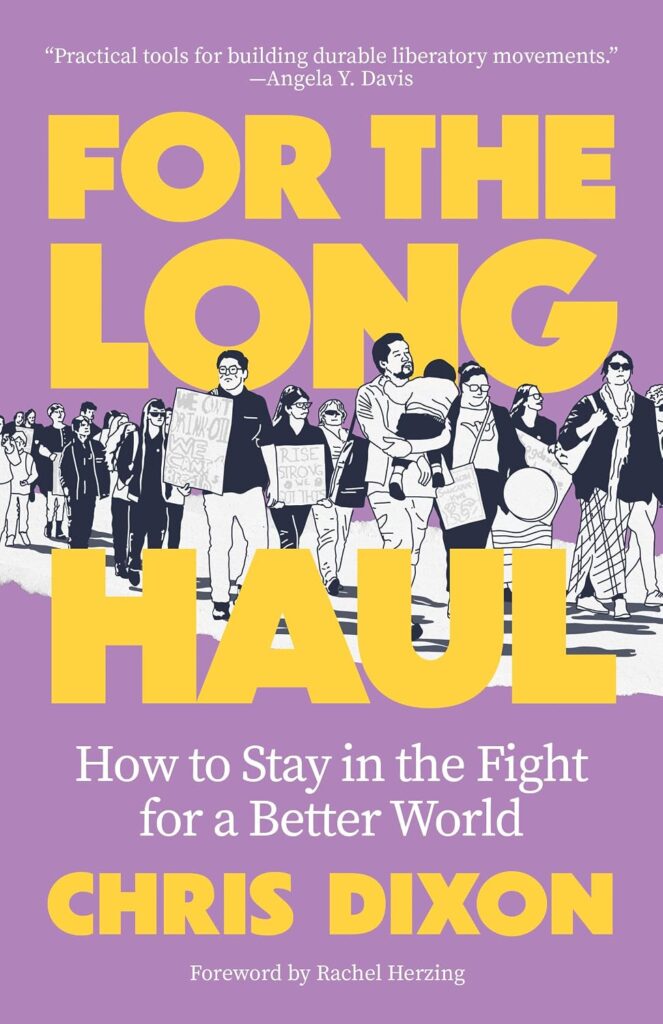
AK Press published For The Long Haul by Chris Dixon in September 2026. I received my copy through AK’s “Friend of the Press” program. I’ve been interested in the general health of our organization for a while, so the book intrigued me immediately. After reading it, I found much of value, so let us review the book structurally and then focus on the book’s ideas that can help us improve.
What inhibits the longevity of liberatory movements and, by extension, how can we encourage ourselves and others to commit and stay committed for the long haul (Dixon 2026, 7-8)? We can cultivate a long view, work with others, care, make plans, and stick around. Dixon organized his book into five chapters with each chapter dedicated to one of those answers. Each chapter breaks down into subsections addressing some aspect of its answer. The order is not strictly logical (as in, A, B, C, and so on). Cultivating a long view (for example) requires resistant remembering, learning from the past, an intergenerational chain of struggle, a global orientation, a struggle within the struggle, remaining open, embracing unpredictability, and staying grounded (Dixon 2026, 13-35). Sometimes we see the guiding logic clearly, and other times we can only vaguely sense the reason behind the order.
The book identifies many issues that plague movements and a few seem applicable to the IWW. We Wobblies suffer from three cooperating issues: a culture of paranoid reading, lack of care, and ineffectiveness. That doesn’t mean we don’t care at all or are totally ineffective, but rather we could do much better and doing better would encourage members to stick around (for the long haul). Cultures of paranoid reading tend “toward suspicion, rivalry, and dismissal” (Dixon 2026, 51). Failing to care about and for each other exacerbates that issue. “When we don’t do this [care] work well or often enough, our movements suffer: people feel excluded and unrecognized, collective efforts are less resilient, participation shrinks, unproductive conflicts flare, people direct their pain at one another, groups flounder and fall apart, and inevitably some people burn out” (Dixon 2026, 73). These two create problems by themselves, but they gain added strength and come to the fore when times get tough, whenever we fail to achieve our goals and/or meaningfully impact others’ lives. As stressors pile up, these toxic tendencies encourage people to turn on each other exactly when they need each other the most (Dixon 2026, 90 and 124). Now, it is not my habit to move on without examples, but in this case, I leave it to the audience to fill in the blanks. I imagine each of us can do so without much difficulty. Thankfully, we can work together to address these issues.
We can combat a culture of paranoid reading and avoid the problems that arise without care by filling ourselves with care. Care, like love or solidarity, breaks into attitudes and acts. Let’s call the attitude side caring about. Caring about others means thinking about and speaking with each other collaboratively, cooperatively, and charitably. We must choose to treat each other better because it’s the most constructive course of action. As we treat people, so will they become. If we want to live in a caring world, we must start caring about each other now and doing so will make that caring world.
Care, like solidarity and love, is also an act. Let’s call this caring for. “Solidarity lies in action,” “[a]ction that sinks its roots in one’s own project,” action that carries on “coherently and proudly too, especially when it might be dangerous to even express one’s ideas publicly” (Carmignani 2009). This probably sounds a lot like the Christian approach to love. That’s because solidarity descends (via the Paris Commune and French Revolution) from brotherly love. Brotherly love means to love someone else as yourself. If I love another as myself, it follows that I will treat them as I would want to be treated. We can get to the same place through Aristotle’s definition of friendship/goodwill, which means to want what’s best for someone else, for their sake and not our own, and to be willing to do that to the extent possible. Kant basically recreates these in his ethics. Brotherly love is not just feeling or believing, but direct action must follow from that love (NIV, James 2:14-26). Caring for others can manifest in “welcoming newly involved people, checking in on those who have experienced trauma or death, transporting people to protests and meetings, cooking for those who are ill or for new parents, hosting potlucks and dance parties, [and] building relationships with activists in other places and movements” (Dixon 2026, 72). Working together is the heart of union, but care is the heart of working together. We even recognize that in the Organizer Training 101 curriculum. So, let’s fill ourselves with care about and for one another and so be(come) fellow workers (Dixon 2026, 80-81).
A culture of paranoid reading and carelessness come to the fore when organizations fail to achieve their goals. We can suppress those subversive tendencies by working together to achieve our goals, which means making plans and planning to win. Making plans has four steps, escape crisis mode, take an intentional moment, strategize, and (after acting) evaluate. This model helps us set and achieve our goals, making us more effective as organizers, unions, and a union overall. Becoming more effective helps crowd out the previous negative tendencies while we work to eliminate them via care. Ineffectiveness also discourages people from sticking around, so increasing our effectiveness encourages people to stick with the union for the long haul and builds our capacity (Dixon 2026, 90). Lastly, this model may help external organizers working with contacts from hot shops in particular because it emphasizes settling down, settling in, setting clear goals and measures and methods before acting.
At a macro-scale, Capital and the State have us locked in “the long emergency” while simultaneously eroding our individual and collective ability to resist through “the long grind down” (Dixon 2026, 91-92 and 39). This means that many anti-capitalist and anti-authoritarian resisters get stuck in crisis mode, “a form of political activity in which we urgently react to [the] emergencies” that together compose the long emergency and this leads to a cycle of “burn[ing] bright, burn[ing] out” (Dixon 2026, 91). But, we can’t really plan if we’re always reacting to the latest crisis and we need to plan because failing to plan is planning to fail (Dixon 2026, 91-92 and 96-97). So, step one, get out of crisis mode (Dixon 2026, 91-92).
To get out of crisis mode, we need perspective and we need time and space to calm down and recollect ourselves. We gain perspective from many sources, but especially by cultivating the long view. The long view can mean looking backward and forward; visualize a line from our locally situated pasts, through our presents, and to our possible futures. The long view can also mean looking around; visualize a horizontal line or panoramic from other peoples and their situated pasts, presents, and futures toward our own and vice versa. Once we put these “crises” in perspective historically and globally, we should take an intentional moment “to revisit our aims and consider options, including the possibility of not moving into urgent action” (Dixon 2026, 93). Slow is smooth and smooth is fast and people often regret their hasty decisions later. So, in times of genuine emergency, the best thing to do is slow down, get perspective, think, deliberate, make plans, and then act.
Cultivating the long view backwards and forwards means (re)discovering and/or (re)creating our histories. History is a story and, like all stories, it gives us a lens to understand our lives through. History helps us put apparent emergencies and crises in perspective. Doing so means realizing that the ecclesiast was mostly right. “Whatever is has already been” and “[w]hat has been will be again” (NIV, Ecc 3:15 and 1:9). That can lead to dismissiveness and/or despair, but these both come from a haughty spirit that thinks it knows more than it does. Take heart because history reveals both permanence and change, and, really, permanence in change and vice versa. Thus, we can gain perspective from our situated histories and avoid despair and dismissiveness by “recognizing and appreciating the limits of what we know,” which is intellectual humility, and by embracing life’s impermanence (Dixon 2026, 29).
Cultivating the long view also means looking around, thinking globally and acting locally (Dixon 2026, 14). Things become increasingly dire for the American working class and our near-kin in the petite bourgeois and lumpen, meaning the independent laborer, farmer, merchant, unemployed, and those in the counter economy. But, many places still have it worse, usually because American capitalists, using the State, actively made/make it worse for them. Many of the things Americans are currently panicking over, such as surveillance, police militarization, state sponsored violence against anyone who isn’t part of the dominant ethnic, sexual, and religious group, and hyper-exploitation, have been happening abroad with US backing for decades and centuries now. Looking around shows us that we share woes and foes with the the working class (obviously) but also the petite-bourgeois and lumpen everywhere. That puts our crises in perspective.
A global perspective can detach us from the local, but we shouldn’t let it. Many “[l]eftists are much more comfortable reaching out to other radicals, or engaging in activism—including helping poor, downtrodden workers elsewhere—than they are organizing their own workplaces” (Lees and Garneau 2020). Somewhere else can mean other jobsites, peoples, and/or places. Looking elsewhere prevents us from acting, from actualizing our potential here and now. As workers, we have power at the job site. Every step away from that battlefield, away from our workplaces, isolates us from our base of power and decreases both our offensive and defensive potential. That’s our home turf and if we want to win this class war, we need the home field advantage. William Carlos Williams once wrote, “[f]rom the shapes of men’s lives imparted by the places where they have experience, good writing springs… One has to learn what the meaning of the local is, for universal purposes. The local is the only thing that is universal” (1969, 16). He was writing about literature, but the same is true for unions. We must root ourselves in the local even as we look toward the universal.
After escaping crisis mode, we should define our aims, success, and measures, then strategize, act, and reevaluate. When defining our goals and metrics, we should collaboratively critique and defend these ideas by asking why. As James C. Scott tells us in Two Cheers for Anarchism, (quantitative) metrics usually begin as a way of measuring something else, some quality, but soon become the goal themselves (2012, 72-80). The number of branch or campaign members began as a way of measuring the branch’s or campaign’s strength and vigor, which are qualities, but it didn’t take long for people to set “reach ten members” as a goal without asking why numbers matter and whether number fairly represents the quality they seek. Failing to define and criticize our aims and measures renders us literally aimless and encourages us to adopt familiar metrics or goals. Most likely, that means adopting goals and measures from Capital and the State and these are almost always a poor fit for any anti-capitalist and/or libertarian movement (Dixon 2026, 104-105). Failing to take this step means we’ll struggle to accomplish anything (or even know if we accomplished anything) except by dumb luck. Step three, we must develop a strategy, “a plan—or set of plans—for moving us from where we are to where we’d like to be” based on our aims (Dixon 2026, 96). To develop a strategy, we must articulate a theory of change, “how we will make change in the world and why we think it will work” and a theory of victory, which is “a guess about how your actions will lead to a desired outcome” and “a map for winning something we want” (Dixon 2026, 98 and 101). Step four, once we’ve done all this and acted, we need to evaluate and measure “what we’ve done against our aims”(Dixon 2026, 103). Evaluating also means revisiting and adjusting our aims, definitions, measures, and tactics based on our new experience.
All in all, while I disagree with some of Dixon’s points and suggestions, particularly the hit-and-runs on self-reliance and individualism, For the Long Haul offers many strong ideas and approaches to developing more resilient movements. There’s enough to like here that I’d recommend it to any Wobbly interested in what they can do individually and what we can do collectively to strengthen our organizing, our branches, and our union as a whole.
Sources
Carmignani, Daniela. “Introduction” in Revolutionary Solidarity. Translated by Jean Weir. The Anarchist Library, 2009. https://theanarchistlibrary.
Dixon, Chris. For the Long Haul: How to Stay in the Fight for a Better World. AK Press, 2026.
Lees, MK and Marianne Garneau. “The Leftwing Deadbeat.” Organizing Work. May 22, 2020. https://organizing.work/2020/
Scott, James C. Two Cheers for Anarchism: Six Easy Pieces on Autonomy, Dignity, and Meaningful Work and Play. Princeton University Press, 2012.
Williams, Carlos William. “Kenneth Burke” in Critical Responses to Kenneth Burke, 1924-1969, edited by William H Rueckert. University of Minnesota Press, 1969.
Disclaimer: The opinions expressed in this article are those of the author. They do not purport to represent that of the IWW or Industrial Worker as a whole.
This piece originally appeared in the 2026 Autumn print edition of Industrial Worker.